
The Future of AI in Cybersecurity: Trends, Risks, and Enterprise Strategies for 2026
Milind Shah · 9/12/2024 · 8 min read

The Future of AI in Cybersecurity: Trends, Risks, and Enterprise Strategies for 2026
Cybersecurity has always been a race between attackers and defenders. What has changed in recent years is the pace of that race. Artificial intelligence (AI) has made it possible to identify threats faster, analyze vast amounts of security data in seconds, and automate tasks that once took security teams hours or even days to complete. At the same time, cybercriminals are using AI to launch more convincing phishing campaigns, create deepfake content, and automate attacks at a scale that was previously difficult to achieve.
For organizations, this presents a new reality. AI is no longer just another technology investment, it has become an essential part of modern cybersecurity. But adopting AI without the right governance, visibility, and security controls can introduce new risks alongside new capabilities.
The conversation has also evolved. A few years ago, businesses focused on how AI I could improve cybersecurity. Today, they must answer a broader question: How can we use AI to strengthen security while protecting AI systems from misuse, manipulation, and data exposure?
This article explores how AI is transforming cybersecurity in 2026, where it delivers measurable value, the emerging risks organizations should prepare for, and the practical steps needed to build a secure, AI-enabled security strategy.
Why AI Has Become Central to Modern Cybersecurity
Cyber threats have become more sophisticated, frequent, and difficult to detect. Organizations are managing cloud environments, remote workforces, connected devices, and third-party applications, all of which expand the potential attack surface. At the same time, security teams are under increasing pressure. The volume of alerts continues to grow, skilled cybersecurity professionals remain in short supply, and attackers can exploit vulnerabilities within minutes of their discovery.
Traditional security tools were designed to detect known threats based on predefined rules. While they still play an important role, they often struggle to keep pace with today's dynamic threat landscape.
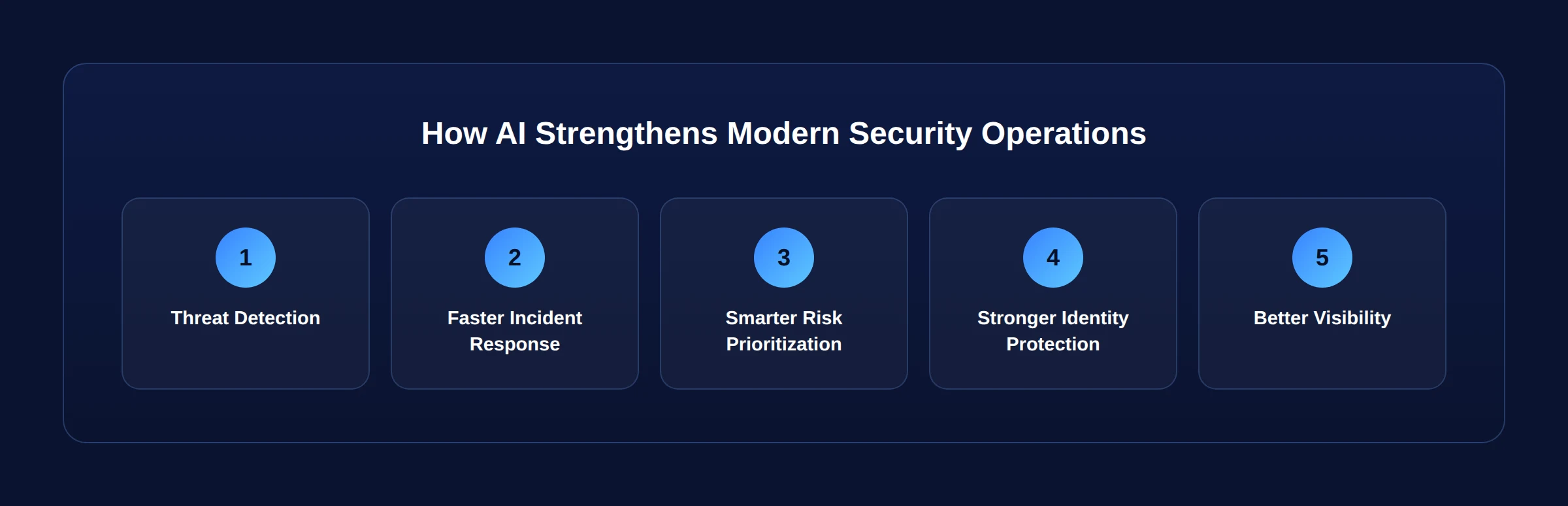
AI addresses this challenge by helping security systems recognize patterns, identify unusual behavior, and prioritize the incidents that require immediate attention. Instead of replacing security professionals, AI enables them to focus on higher-value investigations while reducing time spent on repetitive analysis. This shift is already reshaping security operations across industries:
- Threat detection. AI goes beyond known attack signatures to flag unusual behavior that could indicate an emerging threat.
- Faster incident response. AI connects alerts across systems, surfaces the root cause, and automates routine actions like isolating a compromised device or blocking a malicious IP, so teams spend less time sorting alerts and more time resolving incidents.
- Smarter risk prioritization. Not every vulnerability needs immediate action. AI weighs threat intelligence, business impact, and asset criticality to identify what to fix first.
- Stronger identity protection. Compromised credentials remain a leading cause of breaches. AI monitors user behavior and flags anomalies, logins from unfamiliar locations, unexpected access to sensitive data, without creating friction for legitimate users.
- Better visibility across increasingly complex, distributed IT environments, the same kind of environment complexity Sigma Solve helped one healthcare claims business get in front of when it spun up an independent enterprise IT environment in eight weeks.
The Other Side of AI: How Cyber Threats Are Evolving
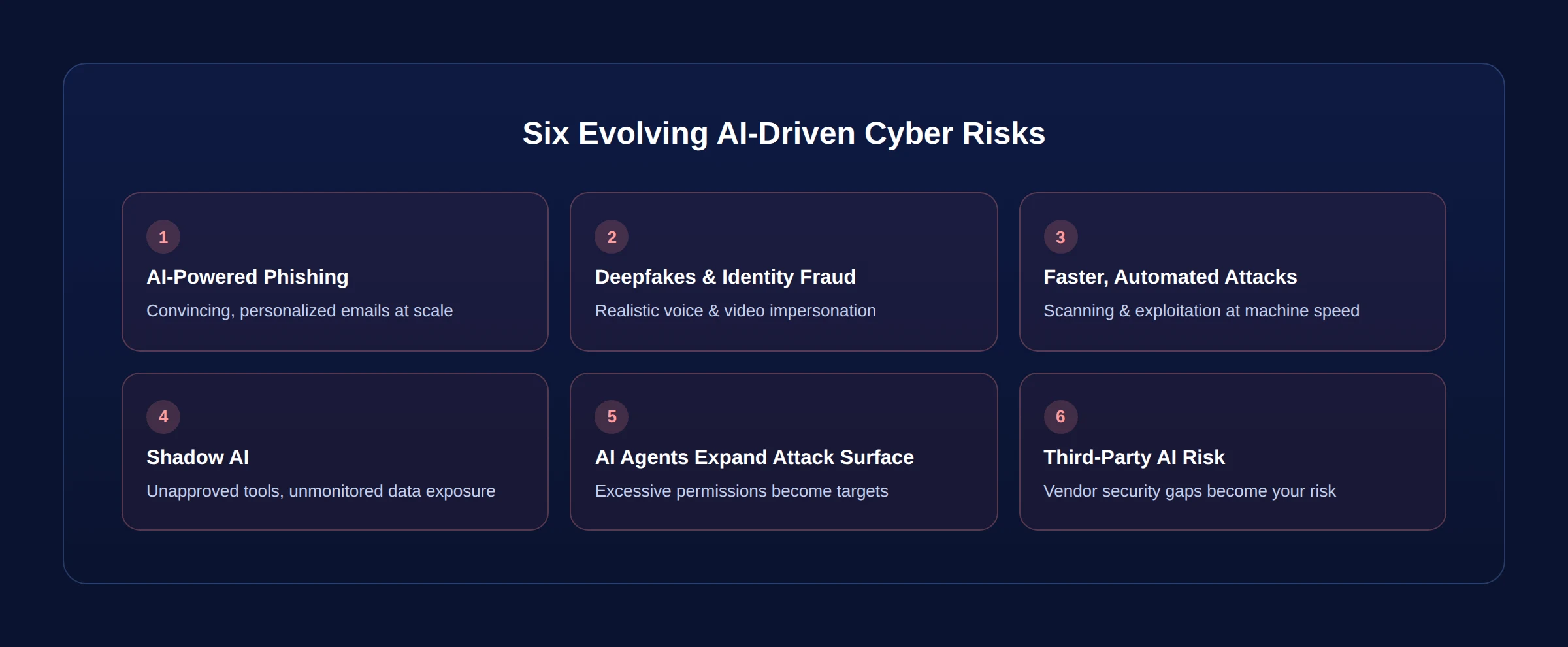
AI is helping organizations strengthen security, but it's also making cyberattacks faster, more targeted, and harder to detect. Rather than creating entirely new attack methods, AI is improving familiar ones, allowing attackers to scale phishing campaigns, automate reconnaissance, and impersonate trusted individuals with greater accuracy. Here are the key risks organizations should prepare for.
- AI-Powered Phishing. Phishing has become far more convincing. Attackers can generate personalized emails that mirror a company's tone, reference ongoing projects, and target employees with surprising accuracy. What to do: Combine employee awareness with stronger email security, identity verification, and continuous monitoring.
- Deepfakes and Identity Fraud. AI-generated voices and videos are making impersonation attacks more realistic. An urgent payment request or access approval that appears to come from a trusted executive may not be genuine. What to do: Verify sensitive requests through a second communication channel and require approvals for high-risk transactions.
- Faster, Automated Attacks. AI allows attackers to scan systems, identify vulnerabilities, and launch attacks much faster than before, leaving organizations less time to respond. What to do: Prioritize continuous monitoring, vulnerability management, and timely patching.
- Shadow AI. Employees increasingly use public AI tools to improve productivity. Without proper governance, they may unintentionally expose confidential business information. What to do: Provide approved AI tools, establish clear usage policies, and educate employees on responsible AI use.
- AI Agents Expand the Attack Surface. AI agents can access business systems, retrieve data, and automate workflows. If they have excessive permissions, they become attractive targets for attackers. What to do: Apply least-privilege access, monitor agent activity, and review permissions regularly.
- Third-Party AI Risks. Most organizations rely on external AI platforms and vendors. Weak security practices within this ecosystem increase business risk. What to do: Evaluate how vendors handle data, manage access, and meet security and compliance requirements.
Best Practices for Secure AI Adoption
AI can strengthen cybersecurity, improve operational efficiency, and accelerate decision-making. But these benefits depend on how AI is implemented, managed, and monitored.
- Protect the data that powers AI. Classify sensitive data, restrict access based on business need, and limit employees to approved AI platforms to reduce accidental exposure.
- Establish clear AI governance. Employees need explicit guidance on where AI can be used, what information can be shared, and who owns oversight.
- Keep humans in the loop. AI can process information at scale, but it can't replace human judgment on decisions with real business, regulatory, or customer impact, financial approvals, privileged access, or incident response.
- Strengthen identity and access controls. AI assistants and agents touch multiple systems. Least-privilege access and regular permission reviews limit the blast radius if one is compromised.
- Evaluate third-party AI solutions carefully. Every vendor you adopt extends your security perimeter. Check how they store data, manage access, and respond to incidents before you sign, the same due diligence that let one Sigma Solve fintech client cut manual review time and strengthen audit readiness with AI-powered compliance automation.
- Build a culture of responsible AI use. Technology alone won't prevent AI-related risk. Regular training on what can be shared with AI tools, and when human review is required, matters as much as the controls themselves.
The Governance Gap: Leadership Isn't Moving as Fast as the Risk
At many organizations, AI-related risk has become a board-level topic in name before it's become one in practice. Leadership calls it important; fewer have turned that into a policy, a budget line, or a named owner. That gap, between acknowledging the risk and acting on it, is where most future incidents will start.
A practical checklist for decision-makers:
- Do we know every AI agent and tool that currently has access to our systems?
- Do our AI agents have clear limits on what they're allowed to do, and can we shut one down quickly if it misbehaves?
- Do we have a lifecycle policy for machine identities, the same way we do for employee accounts?
- Are employees using unapproved AI tools with company data, and would we know if they were?
- Who owns AI security risk at the leadership level, and is it on their agenda, not just their radar?
- Can our security team contain a threat before it disrupts business operations, and do we know our current mean time to containment?
Conclusion
AI is reshaping both sides of the cybersecurity equation, strengthening defenses while giving attackers new capabilities of their own. The organizations that come out ahead won't be the ones that adopt the most AI, but the ones that pair it with governance, identity controls, and human oversight from day one.
Secure Your AI Journey with Sigma Solve
Sigma Solve helps you close the governance gap, from AI agent permissioning and identity controls to full security operations modernization. If you don't currently have answers to the checklist above, that's the starting point.
Connect with our experts to build an AI security strategy grounded in your actual environment, not a generic framework.