
Logistics CRM Software: Features, Benefits, and TMS Integration Guide (2026)
Milind Shah · 11/29/2023 · 6 min read

A logistics CRM is customer relationship management software built for transportation workflows. It brings leads, shippers, carriers, quotes, communication, and orders into one system and connects to your TMS, load boards, and accounting tools, so sales and operations work from the same information.
Many brokers, 3PLs, and transportation companies still run these workflows across spreadsheets, inboxes, and disconnected applications. More than a third of logistics organizations still rely heavily on manual processes, and every manual step slows sales and makes service less consistent. This guide covers what a logistics CRM does, which features matter, how it fits with a TMS, where AI helps, and when a custom build makes sense.
Key takeaway: For most logistics businesses, the answer isn't CRM or TMS. It's CRM plus TMS, connected.
Why Logistics Businesses Need a Connected CRM
A single shipment can involve a shipper, broker, carrier, driver, salesperson, dispatcher, finance team, and customer service representative. When their information lives in different systems, every handoff invites delay or error. Leads arrive from websites, referrals, ads, marketplaces, calls, and email with no central tracking. Quotes wait on information from another department. Teams re-enter the same data between sales and operations. Nobody has a complete view of the customer.
These problems rarely come from a lack of effort. They come from systems never designed to work together, which turns employees into the integration layer.
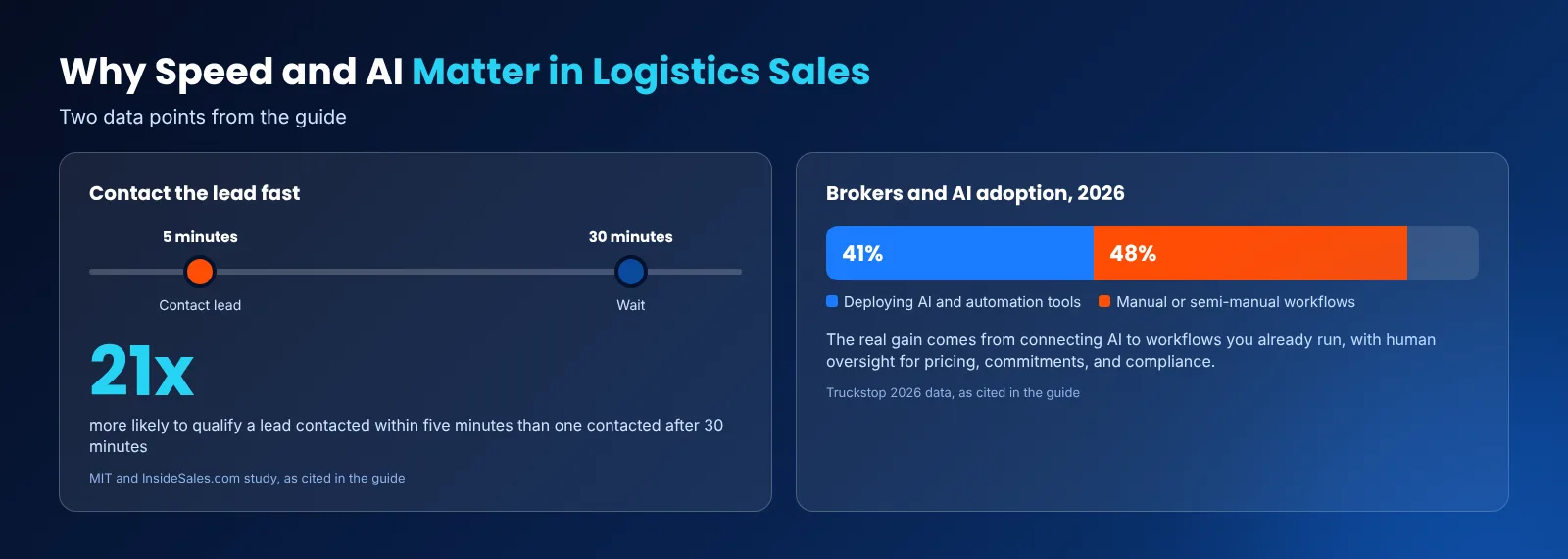
Speed is where the cost shows first. A shipper contacting several providers won't wait long for a reply, and a widely cited MIT and InsideSales.com study found that contacting a lead within five minutes made qualification 21 times more likely than waiting 30 minutes. A connected CRM closes that gap by capturing, assigning, and acknowledging every inquiry automatically, then carrying the order into transportation workflows once it's confirmed.
Key Features of a Modern Logistics CRM
A logistics CRM should reflect how transportation businesses actually work, not simply repackage a generic CRM.
AI-Powered Lead Assignment and Prioritization
AI can route each inquiry using criteria such as customer information, engagement signals, salesperson expertise, and workload. Teams spend less time sorting leads and more time talking to qualified prospects.
Centralized Lead Management
One view of every prospect, from first contact to conversion, replaces separate spreadsheets. You can see who owns each lead, what has happened, what's next, and where opportunities are being lost.
Automated Customer Communication
Emails and texts can fire on events such as a new lead, a submitted quote, a follow-up date, an order confirmation, or a status change. Communication stays consistent, and your team can focus on conversations that need human judgment.
Faster Freight Quoting
Templates, workflow automation, and integrated customer data let sales teams prepare and send quotes without chasing details across departments. The goal is a repeatable quoting process, not just a quick one.
Load Board Integration
Connecting load boards and carrier marketplaces means confirmed orders move into carrier selection, dispatch, and tracking without retyping.
CRM-TMS Integration
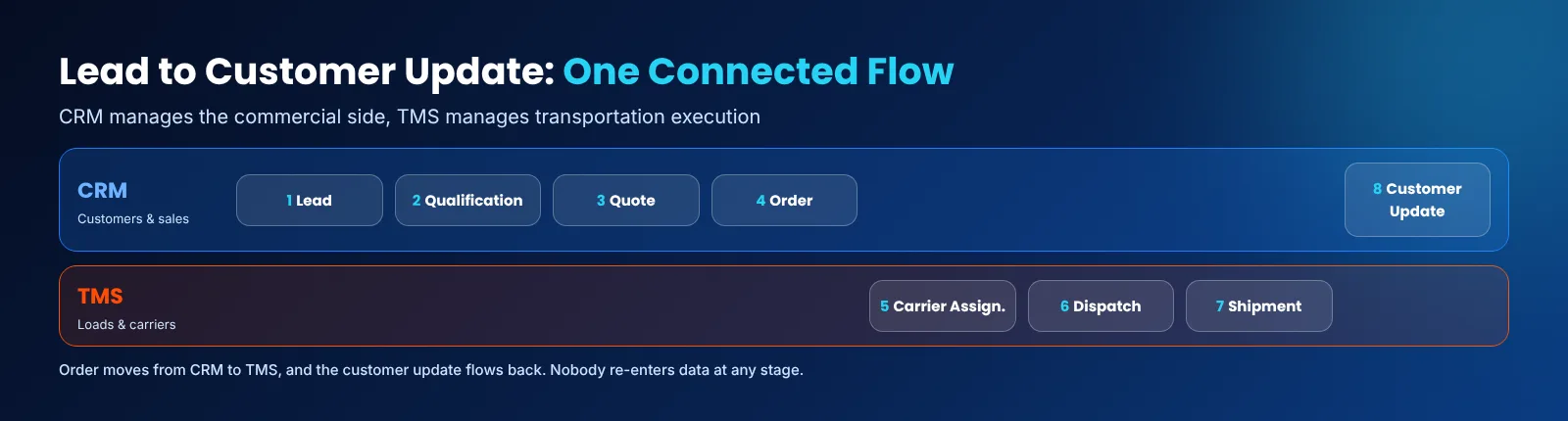
A CRM manages customers, prospects, sales activity, and communication. A TMS manages loads, carriers, dispatch, and shipment execution. Integrating them lets data move through the whole sequence: Lead → Qualification → Quote → Order → Carrier Assignment → Dispatch → Shipment → Customer Update. Nobody has to re-enter it at each stage.
| Capability | Logistics CRM | TMS |
|---|---|---|
| Lead management and sales pipeline | ✓ | — |
| Customer relationship management | ✓ | Limited |
| Customer communication | ✓ | Limited |
| Freight quoting | ✓ | ✓ |
| Carrier management | ✓ | ✓ |
| Dispatch and shipment execution | Limited | ✓ |
| Shipment tracking | Integrated | ✓ |
For most logistics businesses, the answer isn't CRM or TMS. It's CRM plus TMS, connected.
Centralized Shipper and Carrier Profiles
Contacts, communication history, orders, and related data sit in one record, so no one must dig through email to understand a customer's history. This matters more as your customer base and carrier network grow.
Real-Time Reporting
Lead volume, sources, conversion rates, quote activity, pipeline, order volume, revenue trends, and salesperson performance come from one dataset instead of manually merged reports.
Accounting Integration
Connecting to platforms like QuickBooks moves customer and transaction data into invoicing and payment workflows without duplicate entry.
Customizable Workflows
An auto transport broker, a freight brokerage, and a 3PL qualify customers, price loads, and select carriers differently. Configurable fields, permissions, dashboards, and automation rules let the CRM follow your process instead of forcing you into a rigid one.
How AI Is Changing Logistics CRM
AI turns a CRM from a system that stores information into one that helps teams act on it. In logistics, that includes lead scoring, automated follow-ups, interaction summaries, quote assistance, workflow routing, and predictive analytics.
Adoption is still uneven. According to Truckstop's 2026 data, 41% of brokers are deploying AI and automation tools while 48% remain in manual or semi-manual workflows. The real gain comes from connecting AI to workflows you already run. Instead of just flagging an uncontacted lead, an AI-enabled workflow can summarize prior interactions, recommend the next step, and trigger an approved follow-up. Human oversight should stay in place for pricing, customer commitments, and compliance, because the aim is to support logistics teams, not replace their judgment.
When Should You Consider a Custom Logistics CRM?
Off-the-shelf CRMs work well for standardized sales processes. A custom logistics CRM becomes worth considering when you've outgrown them. Typical signs:
- Sales and operations use disconnected systems.
- Staff re-enter the same data repeatedly.
- Leads are hard to track or assign.
- Quote turnaround is inconsistent.
- Your CRM needs constant workarounds.
- CRM and TMS data never meet.
- Management can't trust sales reporting.
- Your workflows are too specific for packaged software.
If several of these sound familiar, the issue is probably your infrastructure, not your people. Customization isn't right for every company, so the investment should be justified by operational complexity, integration needs, and expected outcomes.
How Sigma Solve Can Help
Sigma Solve builds enterprise software and AI-powered solutions that modernize complex workflows. For logistics companies, we design custom CRMs that connect lead management, freight quoting, customer communication, TMS and load board integrations, reporting, and automation around your processes, whether you run a freight brokerage, an auto transport business, or a 3PL. The platform integrates with your existing transportation systems and adapts as your requirements change. Explore how we support logistics and supply chain businesses.
Want to see what a connected CRM could look like for your operation?
Connect with Sigma Solve about a logistics CRM built around your processes.
- Lead management, freight quoting, and customer communication in one system
- TMS, load board, and accounting integrations without re-entering data
- Workflows built for your freight brokerage, auto transport business, or 3PL

Frequently Asked Questions
What is a logistics CRM?
A logistics CRM is software that manages leads, shippers, carriers, quotes, communication, and orders for transportation businesses. It integrates with TMS platforms, load boards, and accounting systems so sales and operations share the same data.
What are the benefits of CRM software for logistics companies?
It centralizes customer data, automates lead management and follow-ups, speeds up quoting, connects sales with operations, reduces manual work, and gives management better reporting.
Should a logistics CRM integrate with a TMS?
Yes, if customer and transportation workflows need to share information. Integration reduces duplicate data entry and connects sales, customer service, and operations.
What is the difference between a CRM and a TMS?
A CRM manages customers, leads, sales activity, and communication. A TMS manages transportation execution: loads, carriers, dispatch, and shipments. Integrating them connects the commercial and operational sides of the business.
How does AI improve a logistics CRM?
AI prioritizes leads, summarizes interactions, recommends next actions, automates routine communication, and assists with quoting. It delivers the most value when connected to your actual workflows and data.