
Cross-Platform Mobile App Development in 2026
Milind Shah · 2/22/2023 · 10 min read

The mobile app era has changed dramatically over the past few years. Today's users switch effortlessly between Android smartphones, iPhones, tablets, foldable devices, smartwatches, and even desktops. Regardless of the device, they expect fast performance, intuitive interfaces, and a seamless experience.
For businesses, meeting these expectations while managing development costs and accelerating release cycles is a growing challenge. Building separate native applications for multiple platforms often requires larger engineering teams, longer development timelines, and higher maintenance costs. This is why cross-platform mobile app development has become a strategic investment rather than simply a cost-saving alternative.
However, choosing cross-platform development isn't just about writing code once and deploying it everywhere. It requires careful consideration of business goals, application complexity, performance requirements, scalability, and long-term maintenance.
In this guide, we'll explore everything you need to know about cross-platform mobile app development in 2026, from understanding the technology and evaluating leading frameworks to selecting the right development approach for long-term success.
What Is Cross-Platform Mobile App Development?
Cross-platform mobile app development is the practice of building a single application that runs across multiple operating systems, primarily Android and iOS, using a shared codebase. Instead of developing and maintaining separate native applications for each platform, developers write most of the application's logic once while deploying it across multiple devices.
This approach enables organizations to deliver consistent digital experiences while reducing engineering effort, simplifying maintenance, and accelerating product launches.
Unlike early cross-platform solutions that often struggled with performance and limited access to native capabilities, today's frameworks have evolved considerably. Modern technologies provide near-native performance, rich UI components, access to device hardware, and strong integration with platform-specific APIs. As a result, many enterprises now build customer-facing applications, internal business tools, and enterprise mobility solutions using cross-platform technologies.
Beyond code reuse, cross-platform development supports a more agile product development lifecycle. Development teams can roll out new features, security updates, and bug fixes simultaneously across platforms, reducing release complexity and ensuring users receive a consistent experience regardless of their device.
For organizations pursuing digital transformation, this translates into faster innovation, improved operational efficiency, and lower total cost of ownership without sacrificing application quality.
Why Businesses Are Choosing Cross-Platform Development in 2026
Cross-platform mobile app development has evolved far beyond being a cost-saving alternative. Today, it enables businesses to accelerate product launches, optimize development costs, and deliver consistent user experiences across Android and iOS, all from a shared codebase. Here's why it's becoming the preferred approach for modern mobile app development.
Accelerate Time-to-Market
Launching quickly can be a significant competitive advantage. With a shared codebase, development teams can build, test, and deploy applications for multiple platforms simultaneously, eliminating duplicate development efforts.
Whether you're validating an MVP, launching a customer-facing app, or modernizing enterprise software, cross-platform development shortens release cycles and helps you respond faster to market opportunities.
Reduce Development and Maintenance Costs
Maintaining separate Android and iOS applications requires additional engineering resources, testing, and ongoing support. Cross-platform frameworks minimize these costs by allowing teams to reuse business logic, UI components, and workflows. Updates, bug fixes, and new features can be deployed from a single codebase, reducing long-term maintenance effort and improving development efficiency.
Deliver a Consistent User Experience
Customers expect a seamless experience regardless of the device they use. Modern frameworks support consistent branding, navigation, and functionality while adapting to platform-specific design standards like Material Design and Apple's Human Interface Guidelines. This ensures a familiar experience without maintaining separate applications.
Accelerate Innovation Through Continuous Releases
Mobile applications are constantly evolving with new features, customer feedback, and security updates. A unified development workflow enables teams to release updates faster, simplify testing, and streamline quality assurance. This supports Agile and DevOps practices, helping businesses innovate continuously without increasing engineering complexity.
Build for Long-Term Scalability
As applications grow, maintaining multiple codebases becomes increasingly difficult. Cross-platform development simplifies long-term scalability by centralizing core application logic while supporting native integrations whenever platform-specific functionality is required. This makes it well-suited for enterprise applications in industries such as retail, healthcare, logistics, and financial services.
Improve Developer Productivity with AI
AI is transforming how modern mobile applications are built. From code generation and debugging to automated testing and documentation, AI-powered development tools help engineering teams reduce repetitive tasks and improve code quality. When combined with modern cross-platform frameworks, AI accelerates development cycles, allowing teams to focus on delivering innovative user experiences instead of routine coding activities.
Native vs. Cross-Platform: Which One Should You Choose?
One of the biggest misconceptions is that native development is always the superior choice. The right approach depends on your application's goals, not just its technical requirements.
Here's a quick comparison.
| Criteria | Native Development | Cross-Platform Development |
|---|---|---|
| Development Speed | Moderate | Fast |
| Initial Cost | High | Lower |
| Maintenance | Separate codebases | Shared codebase |
| Performance | Excellent | Near-native for most business apps |
| Time-to-Market | Longer | Faster |
| Code Reusability | Minimal | High |
| Best Fit | Games, AR/VR, hardware-intensive apps | Business apps, enterprise platforms, eCommerce, healthcare, logistics |
Choose Native Development If:
- You're building graphics-intensive games.
- Your app relies heavily on advanced hardware capabilities.
- Maximum performance is your primary requirement.
- You need extensive platform-specific customization.
Choose Cross-Platform Development If:
- You're launching on both Android and iOS.
- Faster releases are a priority.
- Budget optimization matters.
- Your roadmap includes continuous feature updates.
- Long-term maintenance efficiency is important.
Top Cross-Platform Frameworks in 2026
Choosing the right framework can significantly influence development speed, scalability, maintenance effort, and long-term success. While several frameworks are available, two continue to dominate enterprise mobile development in 2026.
Flutter
Developed by Google, Flutter has become one of the most popular choices for building visually rich, high-performance applications from a single codebase. Its powerful rendering engine and extensive widget library enable developers to create consistent user experiences across Android, iOS, web, and desktop.
Best For
- eCommerce platforms
- Healthcare applications
- Logistics solutions
- Enterprise mobility
- Customer-facing mobile apps
- Rapid MVP development
Why Businesses Choose Flutter
- Near-native performance
- Highly customizable UI
- Faster development with Hot Reload
- Strong Google ecosystem and community support
- Consistent user experience across platforms
Things to Consider
- Requires proficiency in Dart.
- Larger application sizes compared to some native implementations.
React Native
Backed by Meta, React Native remains a strong choice for organizations that already use React for web development. It enables teams to leverage JavaScript expertise while building mobile applications that deliver native-like experiences.
Its extensive ecosystem, reusable components, and active developer community make it particularly attractive for businesses looking to accelerate development without starting from scratch.
Best For
- SaaS platforms
- Startup MVPs
- Retail and eCommerce
- Content-driven applications
- Businesses with existing React teams
Why Businesses Choose React Native
- Large developer community
- Excellent code reusability
- Faster onboarding for React developers
- Mature third-party ecosystem
- Strong support for rapid product iterations
Things to Consider
- Some advanced features may still require native modules.
- Performance optimization becomes increasingly important for graphics-intensive applications.
Kotlin Multiplatform vs. .NET MAUI: Which One Fits Your Technology Stack?
While Flutter and React Native dominate the cross-platform landscape, they're not always the best fit for every business. Organizations with existing investments in Kotlin or Microsoft technologies may benefit more from frameworks designed around their current ecosystems.
Kotlin Multiplatform (KMP)
Unlike traditional cross-platform frameworks, Kotlin Multiplatform focuses on sharing business logic while allowing native UI development. This approach enables Android and iOS apps to maintain platform-specific user experiences while reducing duplicate backend logic.
Best For
- Banking and fintech applications
- Healthcare platforms
- Existing Android-first products
- Performance-sensitive enterprise applications
Why Businesses Choose Kotlin Multiplatform
- Native UI for each platform
- Shared business logic reduces maintenance
- Excellent interoperability with existing Android projects
- Strong long-term support from JetBrains and Google
Things to Consider
- UI development remains platform-specific.
- Smaller community compared to Flutter and React Native.
.NET MAUI
Microsoft's .NET MAUI is a natural evolution of Xamarin and is designed for organizations heavily invested in the Microsoft ecosystem.
It allows developers to build applications for Android, iOS, Windows, and macOS using C# and .NET while integrating seamlessly with Azure services, Microsoft Entra ID, SQL Server, and Visual Studio.
Best For
- Enterprise business applications
- Internal productivity tools
- Manufacturing
- Field service solutions
- Organizations using Microsoft technologies
Why Businesses Choose .NET MAUI
- Familiar environment for C# developers
- Deep integration with Microsoft services
- Shared codebase across desktop and mobile
- Enterprise-grade tooling
Things to Consider
- Smaller open-source community than Flutter.
- Less flexibility for highly customized consumer applications.
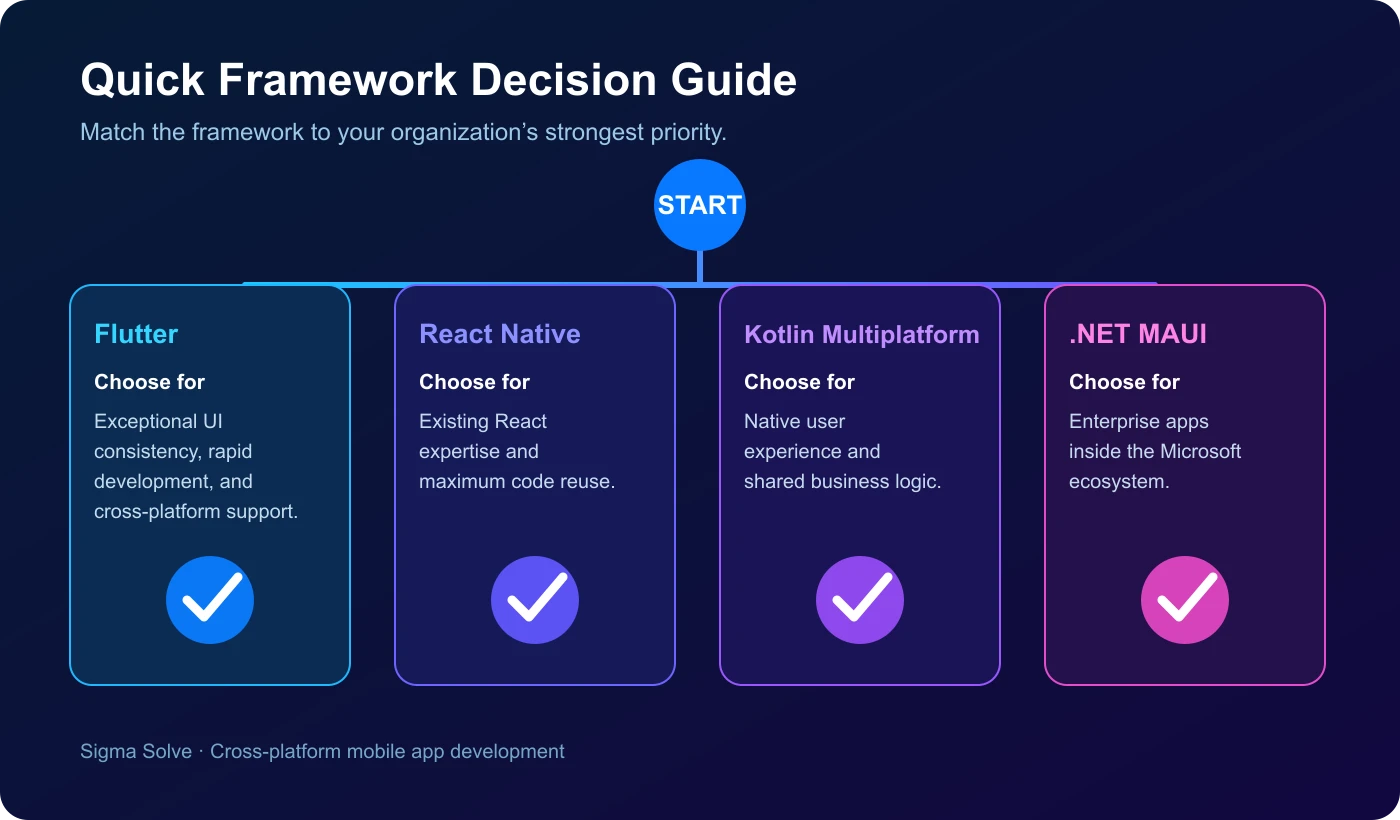
Quick Decision Guide
Choose Flutter if you want exceptional UI consistency, rapid development, and cross-platform support.
Choose React Native if your organization already has React expertise and wants to maximize code reuse.
Choose Kotlin Multiplatform if native user experience and shared business logic are equally important.
Choose .NET MAUI if you're building enterprise applications within the Microsoft ecosystem.
How AI Is Transforming Mobile App Development
Artificial Intelligence is no longer an optional enhancement; it is reshaping how mobile applications are designed, developed, tested, and maintained. From AI-assisted coding to intelligent user experiences, businesses are leveraging AI to accelerate development while delivering more personalized applications. Modern engineering teams use AI-powered development tools to:
- Generate boilerplate code
- Identify bugs before deployment
- Automate documentation
- Improve code quality through intelligent reviews
- Accelerate unit test creation
- Simplify debugging
Building AI-Powered Mobile Experiences
AI is also becoming a core feature of modern applications. Common enterprise use cases include:
- Intelligent chatbots and virtual assistants
- Personalized product recommendations
- Voice-enabled interactions
- OCR and document scanning
- Predictive analytics
- Image recognition
- Smart search experiences
Common Challenges and How to Overcome Them
Cross-platform development simplifies many aspects of application delivery, but it still presents technical challenges that organizations should plan for.
| Challenge | Best Practice |
|---|---|
| Performance bottlenecks | Optimize rendering, minimize unnecessary re-renders, and use native modules where required. |
| Platform-specific features | Build reusable business logic while implementing platform-specific capabilities selectively. |
| Device fragmentation | Test applications across multiple screen sizes, operating systems, and physical devices. |
| Security risks | Implement secure authentication, encrypted storage, certificate pinning, and follow OWASP Mobile Top 10 recommendations. |
| Third-party dependencies | Choose actively maintained libraries with strong community support. |
| Long-term maintenance | Adopt modular architecture and maintain clear documentation for easier upgrades. |
Emerging Trends Shaping Cross-Platform Development
Cross-platform development continues to evolve alongside advances in cloud computing, AI, and connected devices. Here are the trends businesses should watch in 2026:
AI-First Applications
Mobile apps increasingly integrate generative AI, intelligent search, and personalized experiences directly into core workflows.
Offline-First Experiences
Applications are expected to function reliably even with limited or no internet connectivity, synchronizing data once connections are restored.
Cross-Device Continuity
Users expect to start tasks on one device and continue them seamlessly across phones, tablets, desktops, and wearables.
Privacy-First Development
Organizations are prioritizing secure authentication, encrypted data storage, and privacy-by-design principles to meet evolving regulatory requirements.
Cloud-Native Mobile Architectures
Modern applications increasingly rely on cloud services, APIs, serverless computing, and event-driven architectures to improve scalability and resilience.
Final Thoughts
Cross-platform mobile app development has evolved far beyond its early promise of "write once, run anywhere." Today, it's a mature engineering approach that enables businesses to deliver high-quality applications faster, reduce operational complexity, and maximize the value of their technology investments.
Build Future-Ready Mobile Applications with Sigma Solve
From product strategy and UI/UX design to cross-platform development, cloud integration, and ongoing application modernization, Sigma Solve helps businesses build secure, scalable, and high-performing mobile applications tailored to their unique goals.
Whether you're evaluating Flutter, React Native, Kotlin Multiplatform, or .NET MAUI, our experts can help you choose the right architecture, accelerate development, and deliver digital experiences that drive measurable business outcomes.
Ready to transform your mobile app idea into a scalable digital product? Connect with Sigma Solve's mobile app development experts today.