
Why Enterprise AI Pilots Fail and How to Move AI to Production
Shivam B · 9/9/2026 · 10 min read

The enterprise AI problem is no longer about getting AI to work. It is about keeping AI working when conditions are no longer controlled.
A prototype can answer questions, summarize documents, write code, extract information from invoices, recommend actions, or demonstrate an impressive AI agent in a matter of weeks. Production is where the inconvenient variables arrive: permissions change, source data conflicts, users phrase requests differently, APIs fail, context goes stale, costs accumulate, and edge cases appear. An AI system that looked intelligent in a demo starts behaving unpredictably.
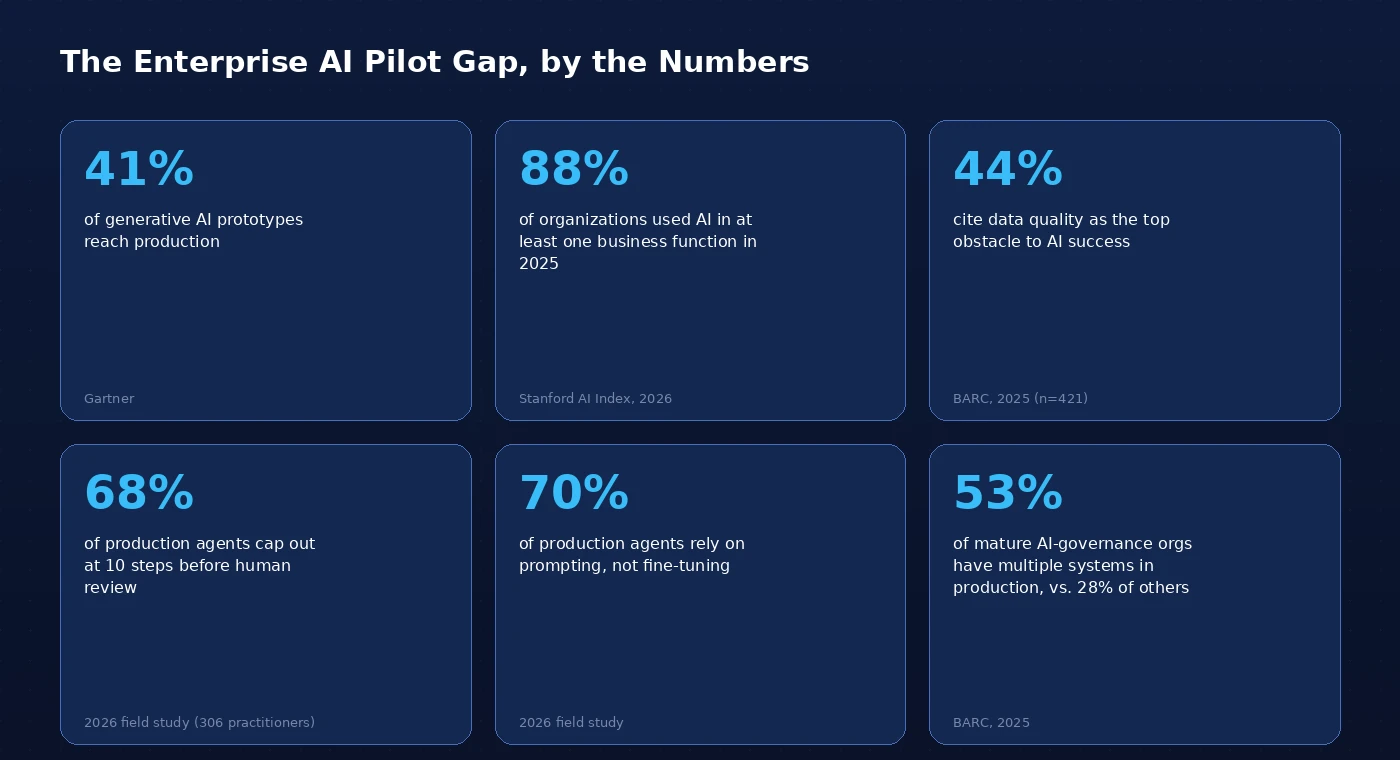
The numbers reflect this gap. Gartner's research found that only 41% of generative AI prototypes and 42% of non-generative AI prototypes reached production. At the same time, AI adoption itself is no longer particularly experimental: Stanford's 2026 AI Index reports that 88% of surveyed organizations used AI in at least one business function in 2025, and 79% reported regular use of generative AI. Yet agent deployment remained relatively limited across individual functions.
So, the bottleneck has shifted. Enterprises know how to build AI demos. They are still learning how to operate AI as infrastructure, and that distinction helps explain why some pilots quietly disappear after an executive demonstration, while others become embedded in customer operations, software engineering, finance, supply chains, and internal workflows.
Capability Questions vs. Behavior Questions
A pilot usually answers a capability question: Can the model classify these documents? Can the agent resolve this type of request? Can generative AI accelerate this task? Those questions are useful but incomplete.
A production system must answer a harder set: What happens when information is missing, or two systems disagree? What happens when the model picks the wrong tool, or a user asks for something outside its authority? What happens when the same request produces different outputs on different runs, or volume jumps from 500 requests to 100,000? What does each successful outcome cost, and who's accountable when the system makes a consequential mistake?
That gap is where most of the difficult engineering work lives, and it's why the industry's early obsession with model selection is giving way to system design. A 2026 field study of production AI agents (306 practitioners, 20 case studies across 26 domains) found reliability to be the leading development challenge. Notably, most production systems were deliberately constrained: 68% executed at most 10 steps before human intervention, and 70% relied on prompting off-the-shelf models rather than fine-tuning. The organizations getting AI into production aren't building the most autonomous systems; they're building systems that know where their autonomy ends.
When the Pilot's Assumptions Go Invisible
The most dangerous pilots aren't the ones that fail visibly; they're the ones that work beautifully because someone is quietly compensating for everything the system can't yet handle. An engineer cleans the data before each run. A subject-matter expert checks every answer. A developer manually corrects failed tool calls. A small group of cooperative users provides predictable inputs. Because the pilot isn't carrying real traffic, nobody is watching latency, retries, or cost.
The result looks like an AI application. Operationally, it's often a human-assisted experiment with software around it, and that hidden effort tends to disappear from the business case. If a document-processing pilot extracts data correctly 95% of the time but employees manually review every document anyway, the 95% figure says little about actual automation. The first production discipline is simple: measure what the system does without the people quietly propping it up.
Data Needs a Hierarchy of Trust and Retrieval Can Fail Silently
"Bad data produces bad AI" is now too broad a statement to be useful. The sharper problem is that AI exposes data inconsistencies that manual workflows were always able to paper over. If a CRM says an account is active, billing shows an overdue balance, and an unfiled contract shows a pending renewal, a human employee knows which system to trust from institutional memory. An AI system just sees three authoritative-looking sources. At pilot scale, someone resolves that manually. At production scale, the architecture needs an explicit answer: which source has precedence, how fresh must data be, what happens when the authoritative system is down, and should the AI escalate rather than guess when confidence is low?
BARC's 2025 research, across 421 organizations, found data quality to be the top obstacle to AI success (cited by 44%) ahead of skills shortages, integration issues, and budget. The fix isn't "clean your data"; it's building an explicit hierarchy of source authority, freshness, lineage, and access scope.
This same fragility shows up in retrieval-augmented generation. RAG lets models work with proprietary, current information instead of relying solely on pretraining, but the model can only produce a grounded answer if retrieval supplies the right context. An answer can be wrong even when the model behaves exactly as designed, because the right document was never retrieved, the wrong version was pulled, relevant text was buried past the context window, or the source had changed since indexing.
Evaluate the Trajectory, not Just the Answer
This matters even more for agents, which don't just answer a prompt; they interpret a request, choose a tool, call an API, inspect the result, decide again, and potentially take an external action. A benchmark that scores only the final answer can miss failures anywhere in that chain. Amazon's 2026 production guidance is explicit that agent evaluation needs to examine task completion, tool selection, reasoning, reliability, safety, and cost, not just the output. An agent can recommend the right supplier while calling the wrong inventory API or reach a correct answer after six unnecessary calls that make the whole workflow economically unsustainable. Correct output, broken execution.
The same logic applies to accuracy targets. Two systems can each hit 95% accuracy, but one makes harmless errors in low-value classification while the other errs once every 20 financial transactions; identical statistics, very different risk. Production AI needs risk-weighted quality thresholds, not a flat number: low-risk actions can be automated, medium-risk actions can require confirmation, high-risk actions stay human-controlled. The goal isn't maximum autonomy; it's maximum useful autonomy inside an acceptable failure boundary, which is exactly why the field research above shows most production agents deliberately capped at a handful of steps before a human checks in.
The Hidden Killer: Unit Economics
Pilots measure cost per model call. Production requires cost per completed business outcome, and those numbers diverge fast. One task might require multiple model calls, retrieval operations, retries, validation, and human escalation before it's done; the model itself may be cheap, but the workflow isn't. An agent making ten tool calls isn't automatically better than one making three; every extra step adds latency and cost. BARC found software costs exceeded expectations for more than half of respondents, with validation, QA, and people costs frequently running higher than planned too. The implication: stress-test the business case at production volume, 10x, 100x, 1000x usage, before committing to scale it.
Observability and Turning Failures into Tests
Traditional monitoring confirms an application is available. AI observability must confirm it's behaving correctly, which means tracing what was asked, what context was retrieved, which model and prompt version ran, which tools were called with what parameters, where the workflow deviated, whether a human intervened, and what it cost. Without that trace, "the AI gave me the wrong answer" is just a starting point for guesswork; engineering still must figure out whether the fault was the model, retrieval, stale data, permissions, or a business rule. AWS's 2026 guidance recommends pairing build-time evaluation with production evaluation, shadow testing, A/B testing, and continuous monitoring, because evaluation shouldn't stop at deployment.
That's also where the best test cases come from. No pilot team can predict every way a real user will phrase a request or combine tasks, so a failed production interaction shouldn't just become a support ticket; it should become a new regression test. Over time, the test suite stops being a static set of developer assumptions and starts reflecting how the enterprise uses the system. That feedback loop, more than any model upgrade, is what separates a mature AI product from a pilot that never grew up.
A Different Path from Pilot to Production
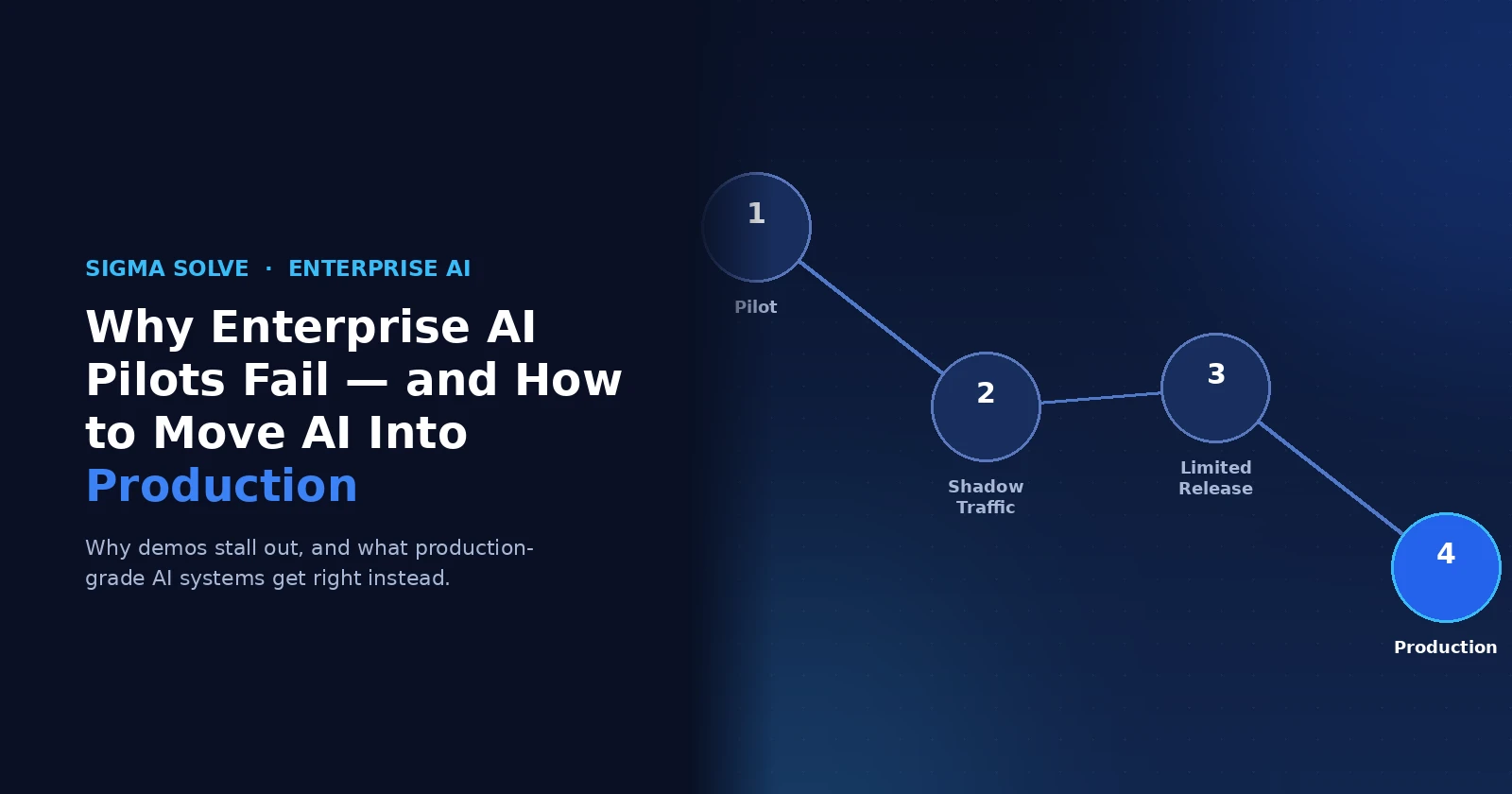
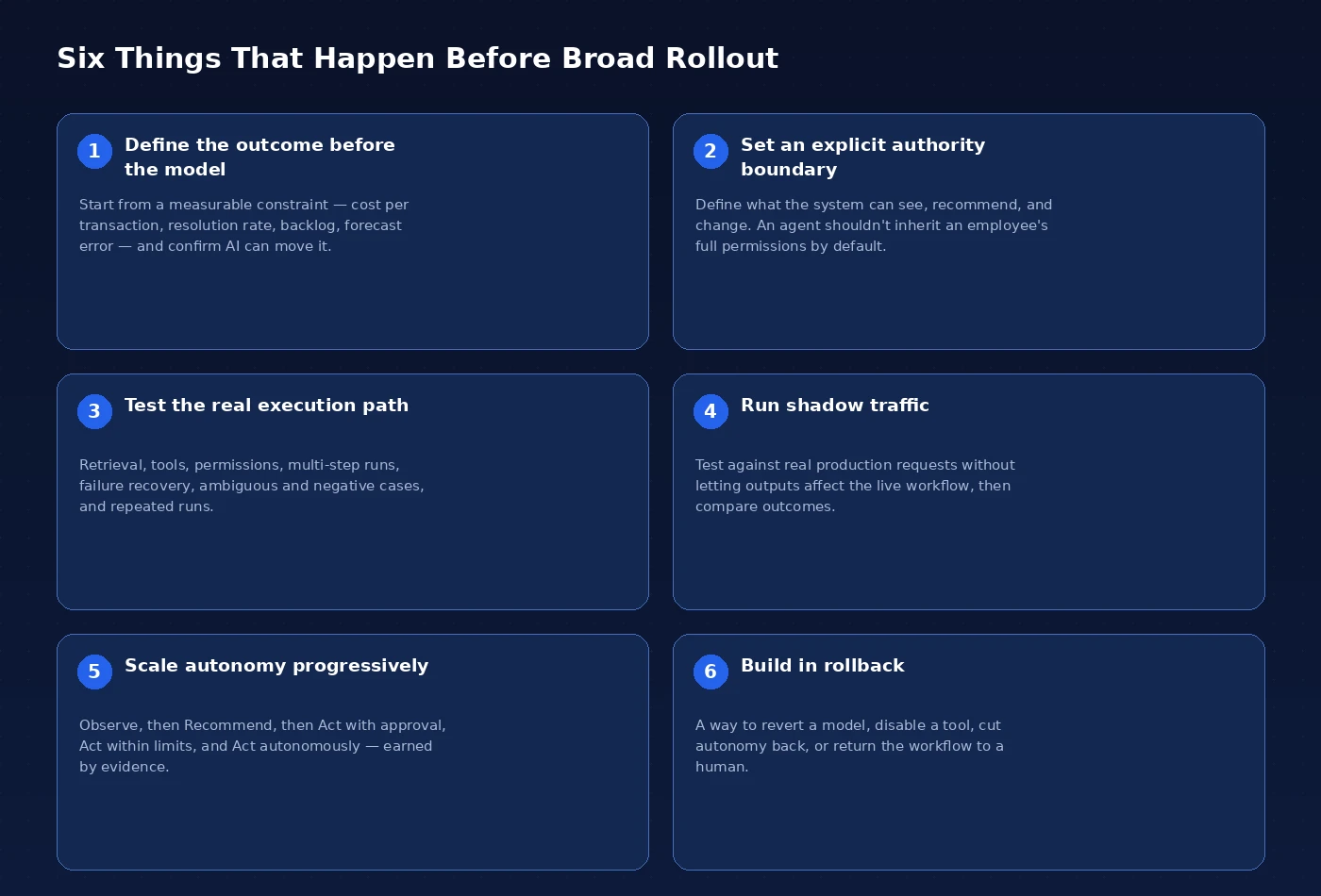
The traditional sequence — idea, prototype, demo, approval, production — is too optimistic for enterprise AI. What works better starts from a real business constraint, running a controlled prototype, then deliberately testing it the way production will stress it: shadow operation, a limited release, and continuous evaluation before anything is called "scaled." In practice, that means six things happen before broad rollout:
- Define the outcome before the model. Start from a measurable constraint: cost per transaction, resolution rate, backlog, forecast error, and confirm AI can move it.
- Set an explicit authority boundary. Define what the system can see, recommend, and change. An agent shouldn't inherit an employee's full permissions by default; its access should match its specific job.
- Test the real execution path, not just final answers: retrieval, tools, permissions, multi-step runs, failure recovery, ambiguous and negative cases, and repeated runs (since non-deterministic systems can pass once and fail the next time).
- Run shadow traffic against real production requests without letting outputs affect the live workflow, then compare what the system would have done to what happened.
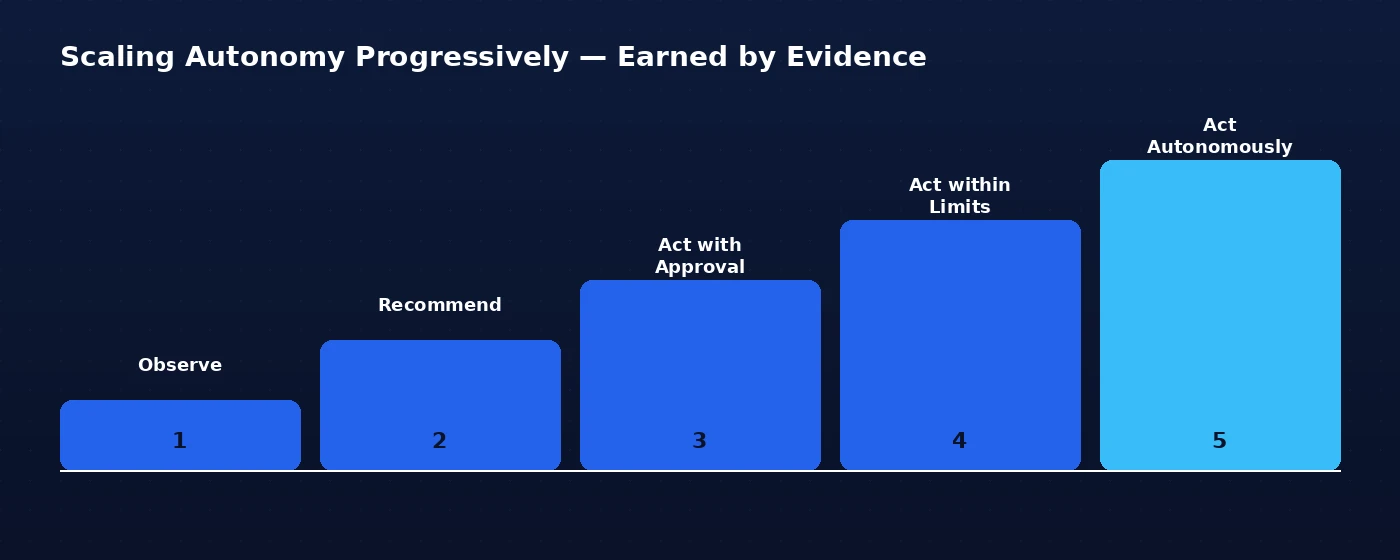
- Scale autonomy progressively: Observe, then Recommend, and Act with approval, Act within limits, and Act autonomously, earned by evidence, not assumed upfront.
- Build in rollback. Because models, prompts, and data sources all change behavior, production needs a way to revert a model, disable a tool, cut autonomy back, or return the workflow to a human; the ability to stop the system is part of readiness.
What the Leaders are Doing Differently
The pattern among enterprises that get multiple AI systems into production isn't a bigger model or more fine-tuning; it's investment in the layer around the model. BARC found organizations with mature AI leadership practices were far more likely to have several projects in production (53% vs. 28% for others), and the differentiator was maturity across governance, architecture, security, and data access, not experimentation volume. That points to a better definition of AI maturity: not how many models an organization has shipped, but its ability to control, evaluate, and improve AI systems under real conditions.
Conclusion
The right question at the end of a pilot isn't "should we go live?" It's "what evidence would make us trust this system with more responsibility?" That single shift in framing changes almost everything downstream: instead of treating production as a finish line, the organization treats it as a standing loop of deployment, observation, and evidence-gathering, where the system earns more traffic and more autonomy only as it proves it can handle them. Stanford's AI Index captures the stakes clearly: AI capability and adoption are accelerating faster than most organizations' ability to measure and manage what they've already deployed.
The companies that close that gap won't be the ones that launched the most pilots. They'll be the ones best at turning uncertain AI behavior into controlled enterprise behavior, the real transition from pilot to production, which has far more to do with evaluation, observability, and authority structures than with a better prompt or a new model benchmark.
If your organization has AI pilots that work in the demo room but haven't earned production traffic, the fastest path forward usually isn't a bigger model; it's a proper evaluation and authority framework, built before the next scale-up decision.
Get in touch to talk through what a production-readiness assessment would look like for your AI initiatives.

Frequently Asked Questions
1. Why do enterprise AI pilots fail to reach production?
Usually not model capability; production demands reliable data access, integration, permissions, evaluation, failure recovery, cost control, and observability that pilots can skip. Gartner found only 41% of generative AI prototypes reach production.
2. What's the real difference between a pilot and production AI?
A pilot shows a capability works under controlled conditions. Production requires the whole system, data, tools, permissions, and cost to hold up under variable, real-world load.
3. How should enterprises evaluate AI agents?
Across task completion, tool selection, retrieval quality, execution path, safety, latency, and cost with repeated runs and negative test cases, not just single-pass benchmarks.
4. Should enterprise AI be fully autonomous?
Not by default. Most reliable production agents are deliberately constrained, with autonomy scaled to the risk and proven reliability of the task.
5. How do you control the cost of AI in production?
Track cost per completed outcome, not per model call, including retrieval, orchestration, retries, and human review, and stress-test that number at real volume before scaling.