
How Much Does It Cost to Develop a Video Streaming App?
Milind Shah · 1/3/2025 · 28 min read

Introduction
Video streaming has evolved far beyond entertainment. While platforms like Netflix, YouTube, and Disney+ helped define the industry, streaming is now a core digital capability across nearly every sector. Healthcare providers offer virtual consultations and medical training through secure video platforms. Educational institutions deliver live and on-demand learning experiences. Fitness brands stream personalized workouts, retailers host live shopping events, and enterprises use private video platforms for employee onboarding, knowledge sharing, and global communication.
As demand for high-quality digital experiences continues to grow, businesses are increasingly investing in custom video streaming applications tailored to their audiences, content strategies, and monetization models. However, one question comes up at the beginning of almost every project:
How much does it cost to build a video streaming app?
The answer isn't as simple as assigning a fixed price. Development costs vary widely depending on factors such as platform type, streaming capabilities, AI-powered features, security requirements, cloud infrastructure, scalability goals, and integration complexity.
This guide breaks down the total cost of building a video streaming platform in 2026 and helps you make informed technology and investment decisions.
How Much Does It Cost to Build a Video Streaming App in 2026?
One of the biggest misconceptions about video streaming development is that there's a standard price. In reality, no two streaming platforms are alike. A simple MVP designed for a niche audience has vastly different requirements from a global OTT service capable of supporting millions of concurrent users.
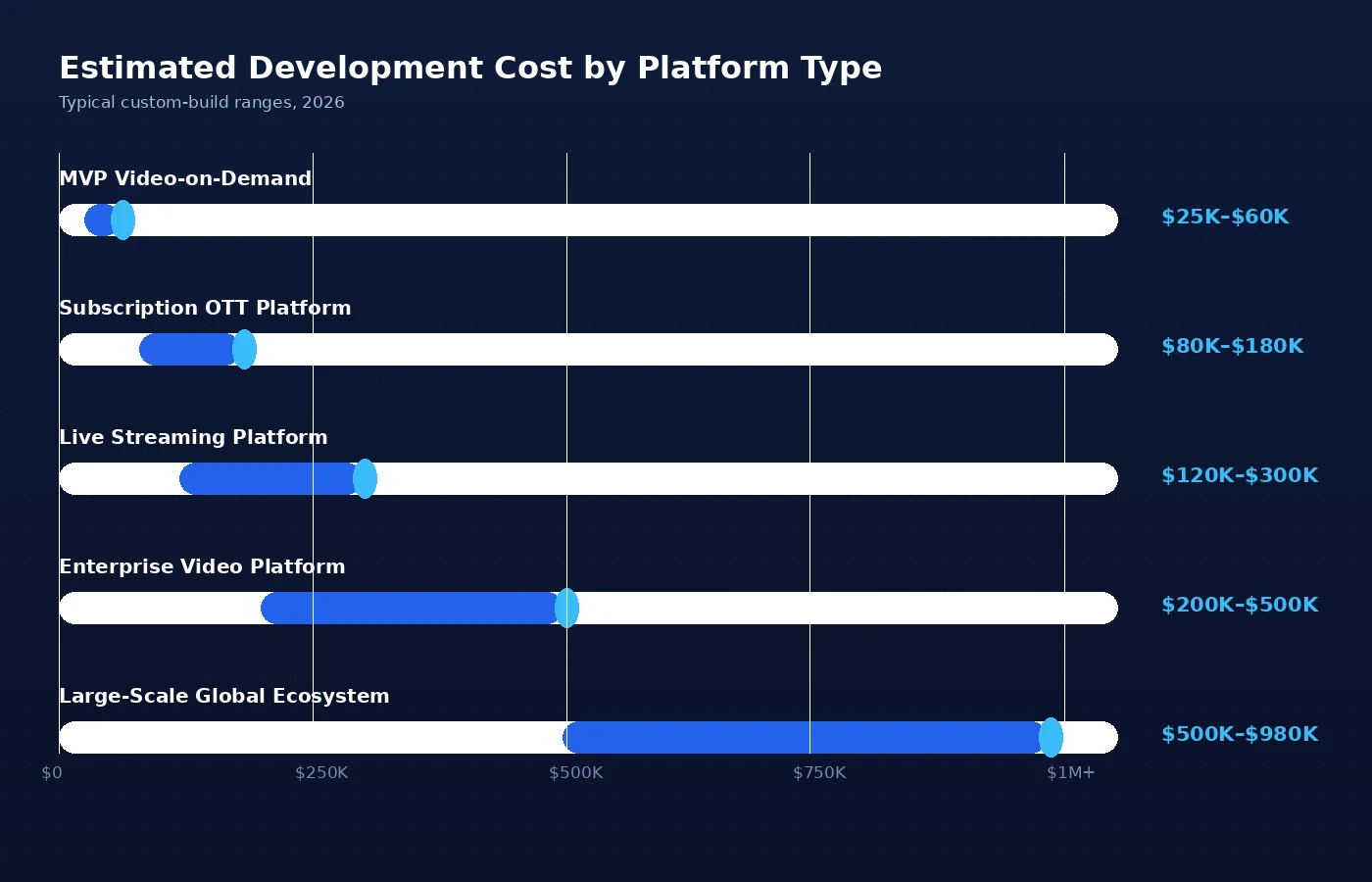
The overall investment depends on several variables, including the type of platform you're building, the number of supported devices, streaming quality, AI capabilities, content management workflows, security measures, third-party integrations, and long-term scalability. The following estimates represent typical development ranges for custom streaming platforms in 2026.
| Platform Type | Estimated Development Cost |
|---|---|
| MVP Video-on-Demand Platform | $25,000–$60,000 |
| Subscription OTT Platform | $80,000–$180,000 |
| Live Streaming Platform | $120,000–$300,000 |
| Enterprise Video Platform | $200,000–$500,000+ |
| Large-Scale Global Streaming Ecosystem | $500,000–$1M+ |
Types of Video Streaming Platform
Not all streaming applications are designed for the same purpose. The intended use case directly impacts architecture, infrastructure, development complexity, and overall cost. Understanding the type of platform you want to build is the first step toward creating an accurate project budget.
Video-on-Demand (VOD) Platforms
VOD platforms allow users to access pre-recorded content whenever they choose. Popular examples include movie libraries, educational courses, recorded webinars, and digital content subscriptions. Common features include:
- Personalized user profiles
- Content categorization
- Search and filtering
- Watchlists
- Resume playback
- Subscription management
- AI-powered recommendations
- Offline downloads
Live Streaming Platforms
Live streaming applications broadcast content in real time, making them ideal for sports events, concerts, conferences, gaming, fitness classes, virtual events, and webinars. Additional technical requirements include:
- Ultra-low latency streaming
- Real-time chat
- Audience engagement tools
- Live moderation
- Stream recording
- Interactive reactions
- Multi-host broadcasting
- Automatic replay generation
OTT (Over-the-Top) Streaming Platforms
OTT platforms deliver premium content directly to users over the internet without relying on traditional cable or satellite providers. Modern OTT solutions typically support:
- Mobile apps
- Smart TV applications
- Web platforms
- Subscription billing
- Content licensing
- DRM protection
- Multi-language support
- Personalized recommendations
- Cross-device synchronization
Enterprise Video Platforms
Many organizations now build secure internal streaming platforms for employee communication, onboarding, training, compliance programs, executive broadcasts, and knowledge management. Enterprise streaming solutions often require:
- Single Sign-On (SSO)
- Role-based access control
- Audit logs
- Internal content management
- Secure video hosting
- Meeting integrations
- Analytics dashboards
- Compliance reporting
Key Factors That Influence Video Streaming App Development Cost
The cost of building a streaming platform isn't determined by a single feature, it's the result of multiple technical and business decisions.
Platform Availability
Supporting iOS, Android, Web, Smart TVs, Roku, Apple TV, Fire TV, or gaming consoles increases both development effort and testing complexity. Every additional platform introduces unique design, performance, and maintenance requirements.
Streaming Quality
Delivering Full HD or 4K content requires advanced encoding pipelines, adaptive bitrate streaming, CDN optimization, and scalable cloud infrastructure. Higher-quality streaming also increases storage and bandwidth costs.
Content Management System
A powerful CMS enables administrators to upload videos, organize libraries, manage metadata, schedule releases, moderate content, and track performance. The complexity of the CMS directly affects development timelines.
User Experience
Features such as personalized homepages, intelligent search, recommendation engines, resume playback, offline viewing, parental controls, and accessibility enhancements improve engagement but require additional engineering effort.
Security & Content Protection
Premium content demands enterprise-grade protection. Implementing Digital Rights Management (DRM), secure authentication, tokenized playback URLs, encryption, watermarking, and geo-restrictions adds both development complexity and licensing costs.
Scalability
A platform serving a few thousand monthly users has very different infrastructure requirements than one supporting millions of concurrent viewers. Designing for scalability from the beginning helps avoid expensive architectural changes as usage grows.
AI-Powered Capabilities
Artificial intelligence is increasingly becoming a standard component of modern streaming platforms. Features such as personalized recommendations, semantic search, automated subtitles, multilingual translation, content moderation, chapter generation, and AI-powered analytics require additional development and cloud AI services but significantly enhance the user experience.
Build vs. Buy vs. Assemble: Which Approach Offers the Best ROI?
One of the biggest decisions organizations face isn't just how much a video streaming platform will cost; it's how they should build it. Five years ago, many companies attempted to develop every component themselves, from video encoding pipelines to streaming servers and content delivery infrastructure. Today, that approach is rarely the most cost-effective or scalable.
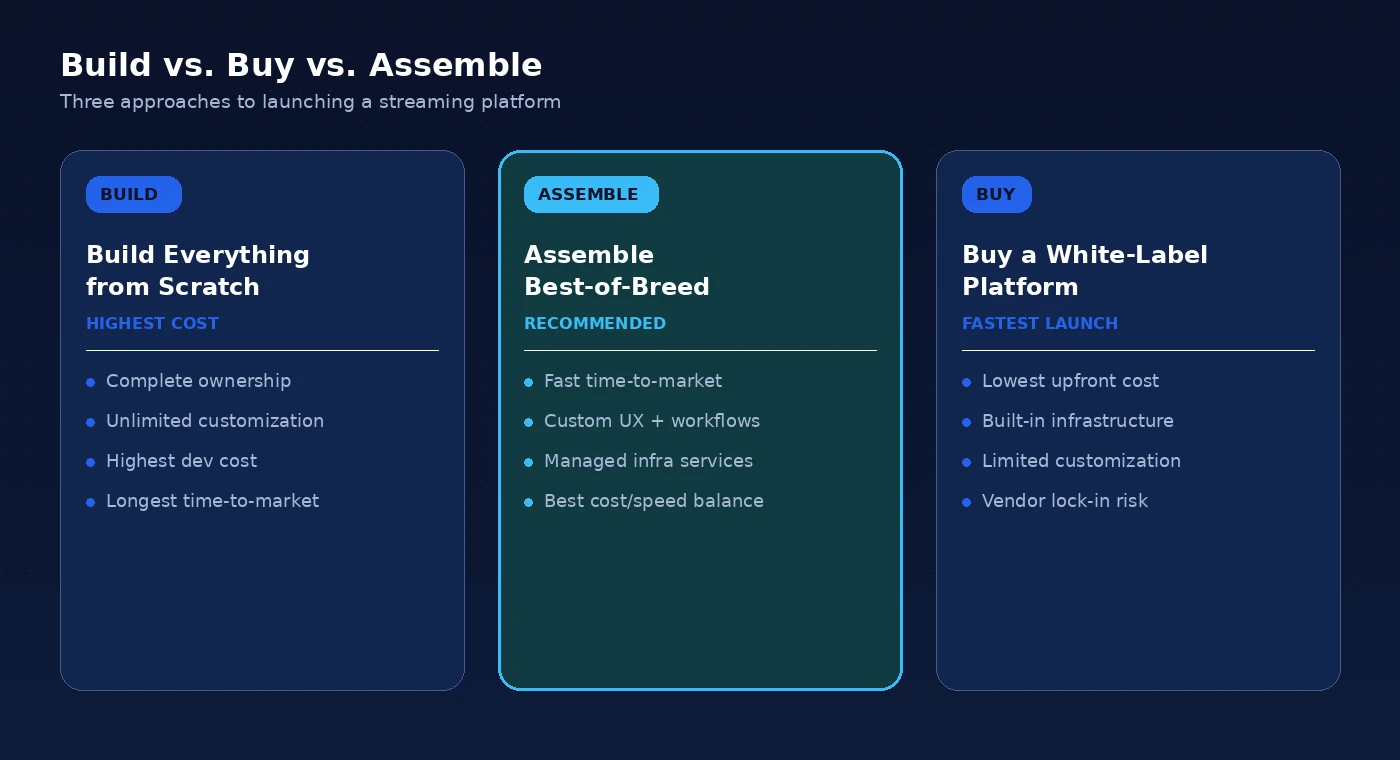
Modern streaming platforms are increasingly built using a combination of custom development and specialized cloud services. This allows organizations to accelerate time-to-market, reduce operational complexity, and focus engineering efforts on features that create competitive differentiation. Let's look at the three most common approaches.
Option 1: Build Everything from Scratch
This approach involves developing every major component internally, including:
- Video upload and processing
- Encoding and transcoding pipelines
- Media storage
- Content Delivery Network (CDN) integration
- Authentication and authorization
- Content Management System
- Recommendation engine
- Analytics platform
- Billing and subscription management
Advantages
- Complete ownership of the platform
- Unlimited customization
- Greater control over security and compliance
- No dependency on third-party platform limitations
Challenges
- Highest development cost
- Longer time-to-market
- Larger engineering team requirements
- Increased infrastructure management
- Higher long-term maintenance costs
Best suited for:
- Large media companies
- Global OTT providers
- Enterprises with unique streaming requirements
- Organizations expecting millions of concurrent viewers
Option 2: Buy a White-Label Streaming Platform
White-label OTT platforms provide ready-made streaming capabilities with minimal development effort.
Businesses typically customize branding, configure subscriptions, and upload content while relying on the vendor's infrastructure.
Advantages
- Fast launch
- Lower upfront investment
- Built-in streaming infrastructure
- Minimal engineering effort
Challenges
- Limited customization
- Vendor lock-in
- Recurring licensing costs
- Less flexibility for future innovation
Best suited for:
- Startups validating ideas
- Training platforms
- Small media businesses
- Organizations with standard streaming requirements
Option 3: Assemble Best-of-Breed Services (Recommended)
This has become the preferred approach for many businesses in 2026. Instead of rebuilding mature infrastructure, organizations integrate specialized cloud services while developing the business-specific experience themselves. A typical architecture might combine:
| Capability | Example Service |
|---|---|
| Authentication | Auth0, Amazon Cognito, Microsoft Entra ID |
| Video Processing | AWS Elemental, Cloudflare Stream, Mux |
| Storage | Amazon S3, Azure Blob Storage |
| CDN | CloudFront, Cloudflare |
| Payments | Stripe |
| Notifications | Firebase |
| AI Services | OpenAI, Azure AI, Google Gemini |
| Analytics | GA4, Mixpanel |
The custom engineering effort focuses on:
- User experience
- Business workflows
- Content management
- AI-powered personalization
- Recommendation engines
- Reporting
- Enterprise integrations
Instead of spending months rebuilding infrastructure that already exists, teams invest their time in capabilities that differentiate the product. For most organizations, this hybrid approach offers the best balance between cost, speed, flexibility, and long-term scalability.
How AI Is Transforming Video Streaming Platforms in 2026
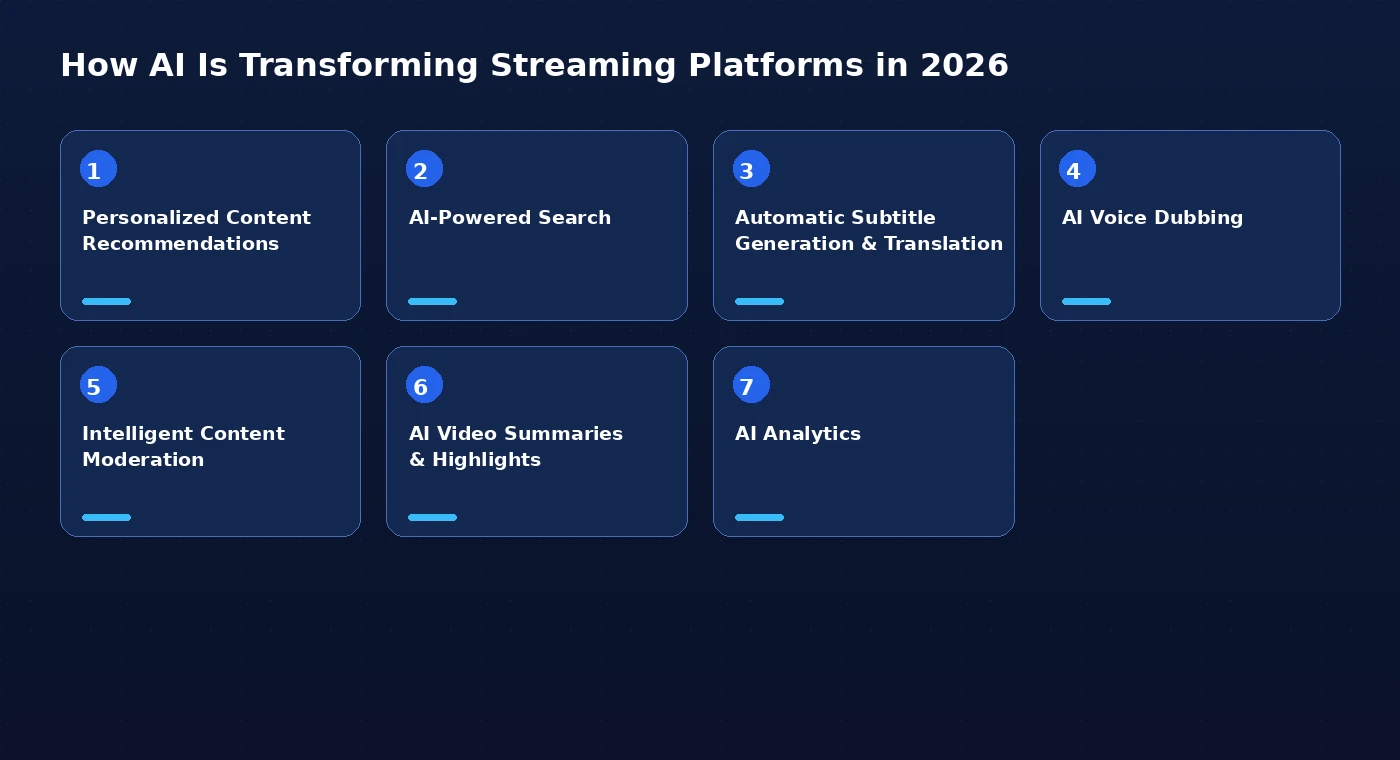
Artificial intelligence has become a defining capability of modern streaming platforms. What was once considered a premium feature is now an essential part of delivering personalized, engaging, and scalable viewing experiences. From content discovery and audience engagement to moderation and operational efficiency, AI is helping streaming platforms improve user satisfaction while reducing manual effort. Here are some of the most impactful AI capabilities shaping video streaming applications in 2026.
- Personalized Content Recommendations
- AI-Powered Search
- Automatic Subtitle Generation & Translation
- AI Voice Dubbing
- Intelligent Content Moderation
- AI Video Summaries and Highlights
- AI Analytics
Common Mistakes That Increase Development Costs
Many organizations unintentionally increase project costs by making avoidable technology and planning decisions. Here are some of the most common pitfalls.
Building Every Component from Scratch
Custom development should focus on business differentiation, not reinventing mature infrastructure such as video encoding, authentication, or CDN management. Leveraging proven cloud services often reduces both cost and risk.
Ignoring Scalability
Designing only for current traffic can lead to expensive architectural changes as the user base grows. Planning for scalability from day one helps avoid future rework and service disruptions.
Overbuilding the MVP
Launching with every possible feature increases development time and delays user feedback. Successful platforms typically begin with a focused MVP, validate market demand, and expand based on real user behavior.
Underestimating Operational Costs
Development is only one part of the investment. Recurring expenses such as cloud infrastructure, bandwidth, storage, monitoring, AI services, and maintenance should be factored into long-term budgeting.
Neglecting Security
Streaming platforms often manage sensitive user data and premium content. Failing to implement secure authentication, DRM, encryption, and role-based access controls can result in compliance issues, piracy, and reputational damage.
Future Trends Shaping Video Streaming
Video streaming continues to evolve rapidly as AI, cloud computing, and immersive technologies reshape how content is created, delivered, and consumed. Some of the most important trends include:
- AI-Generated Video Highlights — Automatically generating short clips from longer videos for social sharing and content promotion.
- Hyper-Personalized Streaming — Dynamic homepages and recommendations tailored to each viewer based on real-time behavior and preferences.
- Interactive Streaming — Features such as live polls, quizzes, shopping experiences, and audience participation are transforming passive viewing into interactive engagement.
- Multi-Cloud Streaming Infrastructure — Organizations are increasingly distributing workloads across multiple cloud providers to improve resilience, reduce latency, and optimize costs.
- Edge Streaming — Processing and delivering content closer to end users helps reduce buffering and improve playback quality, particularly for global audiences.
- AI-Powered Content Operations — AI is streamlining repetitive workflows such as metadata generation, content tagging, localization, moderation, and quality assurance, enabling content teams to operate more efficiently.
Why Choose Sigma Solve for Video Streaming App Development?
Building a successful streaming platform requires more than application development. It demands expertise in cloud infrastructure, scalable architecture, video processing, AI integration, security, and user experience. At Sigma Solve, we help organizations design and develop secure, scalable, and future-ready video streaming solutions tailored to their business goals.
Whether you're launching a new streaming service or modernizing an existing platform, our engineering teams help accelerate development while ensuring long-term scalability and operational resilience.

Frequently Asked Questions
1. How much does it cost to build a video streaming app?
The cost depends on the platform's scope, supported devices, feature set, cloud infrastructure, and scalability requirements. An MVP typically starts around $25,000, while enterprise-grade streaming ecosystems can exceed $1 million.
2. How long does it take to develop a streaming platform?
Development timelines vary based on complexity.
- MVP: 3–5 months
- Mid-sized OTT platform: 6–9 months
- Enterprise streaming ecosystem: 9–15+ months
3. Which technologies are commonly used?
Modern streaming platforms often combine technologies such as Flutter or React Native for mobile apps, React or Next.js for web applications, Node.js or Go for backend services, cloud platforms like AWS, Azure, or Google Cloud, and streaming protocols such as HLS, MPEG-DASH, and WebRTC.
4. Can AI reduce development or operational costs?
Yes. AI can automate tasks like subtitle generation, content tagging, moderation, localization, recommendations, analytics, and customer support. While AI introduces additional implementation costs, it often reduces long-term operational effort and enhances user engagement.