Best Mobile App Development Frameworks in 2026: A Practical Guide
Milind Shah · 10/23/2024 · 10 min read

Choosing a mobile app development framework in 2026 is no longer simply a decision between native and cross-platform development. Businesses and development teams now have several mature approaches for building applications across iOS, Android, desktop and, in some cases, web.
The more important question is not which framework is universally "best," but which technology aligns with the application's requirements, existing technical expertise, expected user experience, platform-specific functionality and long-term maintenance strategy.
Frameworks such as Flutter and React Native continue to make cross-platform development attractive, while Kotlin Multiplatform has strengthened the case for sharing business logic without giving up native platform experiences. .NET MAUI remains relevant for organizations invested in the Microsoft ecosystem, while SwiftUI and Jetpack Compose have become important choices for teams prioritizing native Apple and Android development. Web-first teams can also consider Ionic with Capacitor when extending existing web applications to mobile makes more sense than adopting a dedicated cross-platform UI framework.
This blog examines the leading mobile app development frameworks and technologies in 2026, explains where each approach fits, and highlights the factors businesses should evaluate before making a technology decision.
What Is a Mobile App Development Framework?
A mobile app development framework provides the programming tools, libraries, components, and development environment required to build mobile applications. Depending on the technology, a framework can provide everything from user-interface components and application architecture to platform integrations, debugging tools, and mechanisms for sharing code across operating systems.
The important distinction in 2026 is that not every mobile development technology follows the same model.
- Flutter and React Native are cross-platform frameworks designed to help teams build applications for multiple platforms while sharing substantial portions of the codebase.
- Kotlin Multiplatform takes a more flexible approach, allowing teams to share selected application logic or, when appropriate, more of the application, including its UI through Compose Multiplatform.
- .NET MAUI provides cross-platform development within the C# and .NET ecosystem.
- SwiftUI and Jetpack Compose are native UI technologies for Apple's and Google's platforms, respectively.
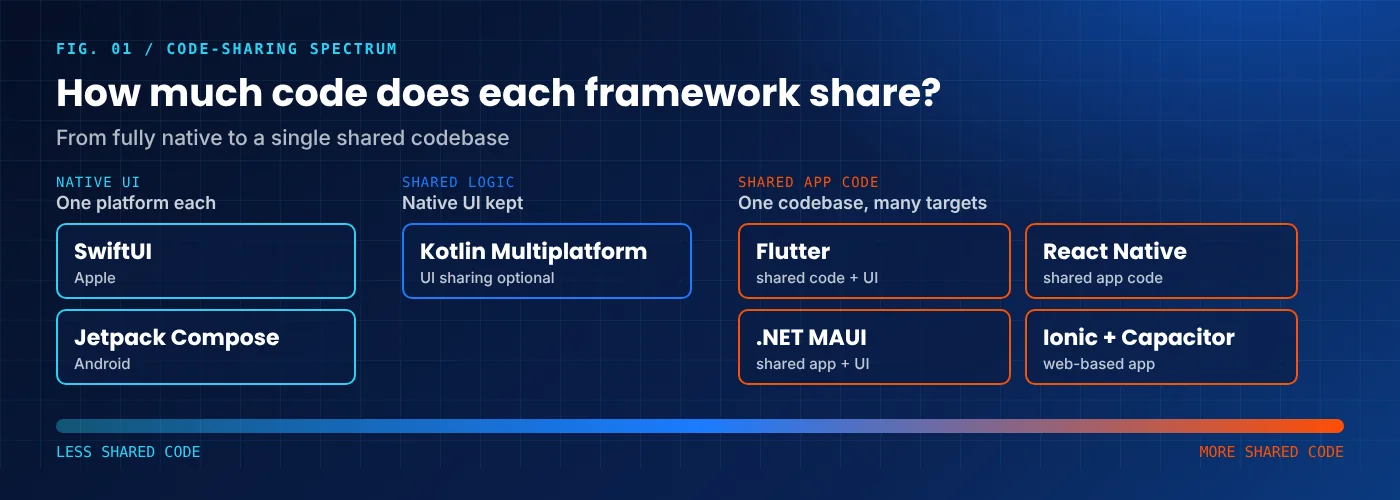
Understanding these differences is essential because the amount of code a team can share is only one part of the framework decision. Platform integration, user experience, performance requirements, developer expertise, and long-term maintainability can be equally important.
How Mobile App Development Has Changed
The mobile development landscape has moved considerably beyond the traditional "write once, run everywhere" proposition.
Earlier cross-platform approaches often focused primarily on reducing duplicated development work. Modern frameworks increasingly provide different ways of balancing shared code with native capabilities. Some allow developers to share most of the application, while others deliberately let teams share only business logic and retain native interfaces where platform-specific behavior matters.
This distinction is particularly important for enterprise applications. A financial application, healthcare product, or sophisticated consumer platform may benefit from native platform capabilities even when substantial business logic can be shared. Conversely, a product with a highly customized visual identity and relatively similar experiences across iOS and Android may benefit from a framework that allows the UI itself to be shared.
The right decision therefore depends on the architecture and business requirements rather than on framework popularity alone.
Best Mobile App Development Frameworks and Technologies in 2026
1. Flutter
Flutter remains one of the strongest choices for teams looking to build cross-platform applications from a shared codebase. Developed by Google and based on Dart, Flutter supports mobile, web, desktop, and embedded targets. Its approach gives developers substantial control over the rendering and visual presentation of an application, which can be particularly valuable when a product requires a consistent and highly customized interface.
One of Flutter's major advantages is the ability to develop a common UI and application experience across platforms without relying exclusively on the native UI components of each operating system. Hot Reload also supports rapid iteration during development, allowing teams to make changes and quickly evaluate their effect.
2. React Native
React Native remains a major option for cross-platform mobile development, particularly for organizations that already use React, JavaScript, or TypeScript. It allows teams to build mobile applications using React-based development patterns while sharing application code across iOS and Android.
Its biggest strategic advantage is often the developer ecosystem surrounding it. Organizations that already have web developers working with React and TypeScript can potentially extend existing knowledge and engineering practices into mobile development instead of introducing an entirely different technology stack.
React Native has also evolved significantly from its earlier architecture. The platform's New Architecture, including technologies such as Fabric and TurboModules, has been central to its modernization, while Hermes continues to play an important role in JavaScript execution. Recent React Native releases have continued removing legacy architecture components, making the modern architecture increasingly important for new applications.
3. Kotlin Multiplatform
Kotlin Multiplatform has become one of the most important technologies to consider when evaluating cross-platform mobile development in 2026. Its biggest distinction is that it does not force teams into a single approach to code sharing.
A team can share business logic such as networking, data processing, validation, authentication, and domain logic while maintaining native user interfaces for iOS and Android. Alternatively, with Compose Multiplatform, teams can share substantially more of the application, including UI, when that approach makes sense. Kotlin's official documentation specifically highlights this flexibility, allowing teams to begin with limited code sharing and expand it over time.
This makes Kotlin Multiplatform particularly interesting for products where native platform behavior matters but duplicated business logic across iOS and Android would create unnecessary maintenance.
4. .NET MAUI
.NET MAUI is Microsoft's cross-platform framework for building native mobile and desktop applications with C# and .NET. It allows developers to target Android, iOS, macOS, and Windows through a shared project and codebase.
For organizations already using Microsoft's technology stack, .NET MAUI can be a logical choice because developers can work within the broader C# and .NET ecosystem. Integration with Visual Studio and existing .NET services can also simplify development for teams that already have established Microsoft-based engineering practices.
5. SwiftUI
SwiftUI represents a different approach from cross-platform frameworks such as Flutter and React Native. It is Apple's declarative UI framework for building applications across Apple's ecosystem using Swift.
For applications where Apple platforms are the primary focus, SwiftUI provides direct access to Apple's development ecosystem and enables teams to build modern interfaces using a declarative programming model. Apple continues to expand SwiftUI with new APIs and capabilities; its 2026 updates include improvements to layouts, reordering, swipe actions, state management, and other areas of application development.
6. Jetpack Compose
Jetpack Compose is Google's modern declarative UI toolkit for Android development. Like SwiftUI, it should not be treated as a direct cross-platform alternative to Flutter or React Native.
Compose allows Android teams to build modern interfaces using Kotlin while reducing the amount of traditional UI boilerplate associated with older Android development approaches. Its declarative model is particularly useful for building dynamic interfaces and managing complex UI states.
Jetpack Compose is a strong choice for Android-first products where access to the Android platform and its capabilities is more important than maintaining a single UI implementation across operating systems.
7. Ionic with Capacitor
Ionic remains relevant for organizations with strong web development expertise that want to extend web technologies into mobile applications. Its modern positioning is closely associated with Capacitor, which provides a bridge between web applications and native device functionality.
This makes Ionic particularly attractive when a business already has a web application, design system, or web development team and wants to reuse substantial portions of that investment for mobile.
The approach is different from Flutter or React Native because the application remains fundamentally web-based. That can provide significant productivity advantages for the right product, but teams need to evaluate whether a WebView-based approach is appropriate for applications requiring demanding graphics, intensive native processing, or highly platform-specific experiences.
Flutter vs React Native vs Kotlin Multiplatform vs .NET MAUI
There is no universal winner among the leading cross-platform technologies. The better question is which development model best matches the product and the team behind it.
| Technology | Primary language | Code-sharing approach | Major strength | Consider when |
|---|---|---|---|---|
| Flutter | Dart | Extensive shared code and UI | Consistent, highly customizable UI | You want a unified cross-platform experience |
| React Native | JavaScript/TypeScript | Shared application code with native integration | React ecosystem and developer availability | Your organization already uses React |
| Kotlin Multiplatform | Kotlin | Selective or extensive sharing | Native flexibility with shared logic | Native UX and code sharing both matter |
| .NET MAUI | C# | Shared application and UI code | .NET ecosystem integration | Your organization is Microsoft-centric |
| Ionic + Capacitor | JavaScript/TypeScript | Web-based shared application | Reuse of web skills and code | Your product and team are strongly web-oriented |
Native vs Cross-Platform App Development in 2026
The decision between native and cross-platform development should not be reduced to performance versus cost.
Native development can be the better choice when an application depends heavily on platform-specific capabilities, requires the latest operating-system APIs immediately, or needs an interface that closely follows the conventions of a particular platform. It can also simplify access to platform-specific functionality because developers work directly within the operating system's preferred technology stack.
Cross-platform development becomes more attractive when the business needs to launch on both iOS and Android, wants to reduce duplicated engineering work, or has a strong need for a consistent product experience across platforms.
There is also an increasingly important middle ground. Kotlin Multiplatform demonstrates how teams can share core business logic while maintaining native UI. This approach can provide more flexibility than treating cross-platform development as an all-or-nothing decision.
Businesses should ask not simply, "Should we build native or cross-platform?" but rather, "Which parts of our application benefit from sharing, and which parts need to remain platform-specific?"
How to Choose the Right Mobile App Development Framework
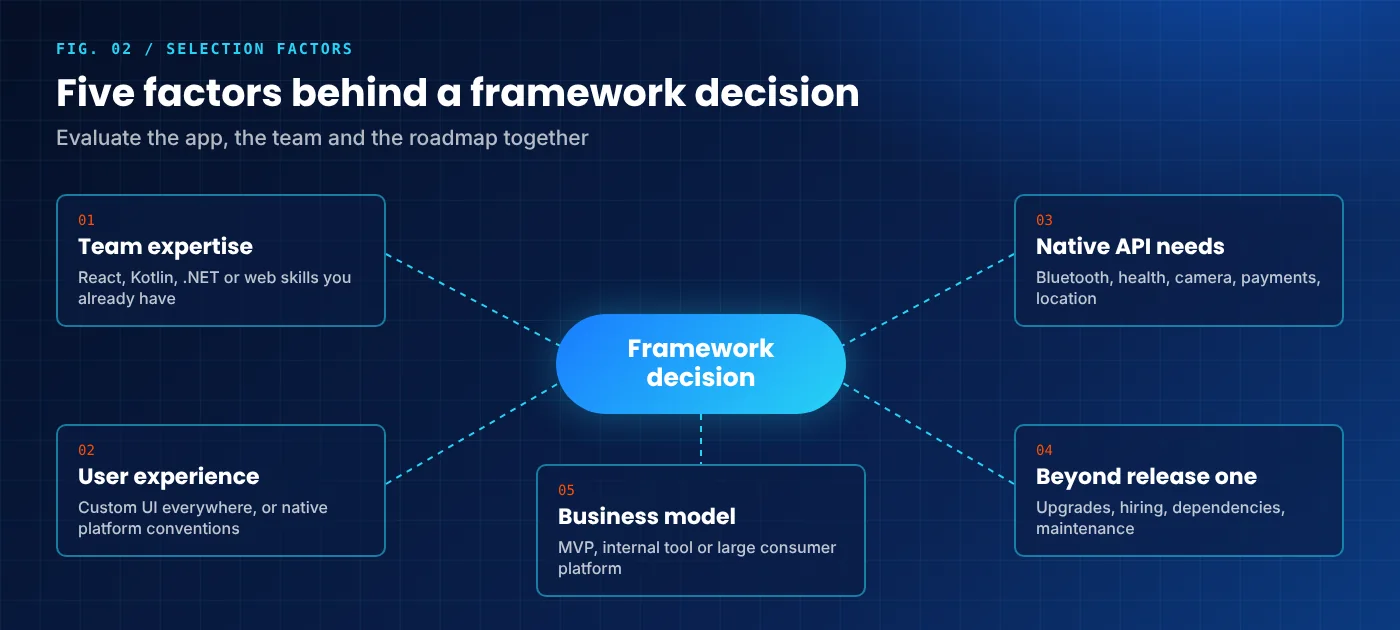
The right framework should be selected after evaluating the application, team, and long-term product strategy together.
Consider Your Existing Technical Expertise
A team experienced in React and TypeScript may be more productive with React Native. A Kotlin-heavy Android organization may find Kotlin Multiplatform a natural extension of its existing capabilities. A Microsoft-focused enterprise may have a stronger business case for .NET MAUI.
Introducing a new programming language is not necessarily wrong, but the additional training, hiring, and maintenance requirements should be included in the decision.
Evaluate the Required User Experience
If the product requires a highly customized and consistent interface across platforms, Flutter may be attractive. If platform-specific conventions are central to the experience, native development or a technology such as Kotlin Multiplatform with native UI may be more appropriate.
Consider Native API Requirements
Applications using Bluetooth, health data, advanced camera functionality, background processing, payments, location services or other platform-specific capabilities should be evaluated carefully before selecting a framework.
A framework that looks efficient during initial development can become expensive if the application eventually requires extensive native workarounds.
Think Beyond the First Release
Framework selection affects more than time to market. The technology will influence future upgrades, developer hiring, dependency management, platform support, and the cost of introducing new capabilities.
A slightly slower first release can sometimes result in a much more maintainable architecture over several years.
Evaluate the Business Model
An MVP, an internal enterprise application, and a large-scale consumer platform may have completely different technology requirements.
For example, rapid cross-platform development can be particularly valuable for validating a new product, while a long-lived enterprise application may place greater emphasis on maintainability, native integrations and the organization's existing engineering ecosystem.
Which Mobile App Development Framework Is Best for Your Project?
The answer depends on what the application needs to achieve.
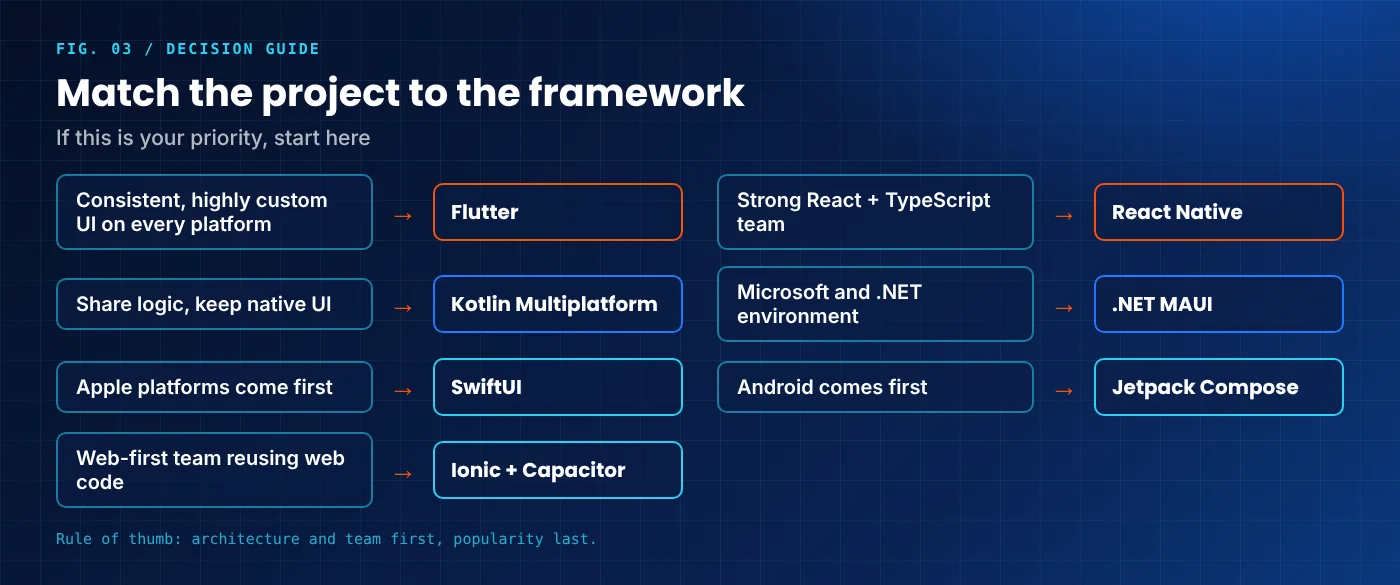
- Choose Flutter when a consistent, highly customized interface across multiple platforms is a major requirement.
- Choose React Native when your organization already has strong React and TypeScript expertise and wants to extend that ecosystem into mobile development.
- Choose Kotlin Multiplatform when you want to share business logic while retaining native platform experiences, or when you want the flexibility to increase code sharing over time.
- Choose .NET MAUI when your application belongs to a broader Microsoft and .NET technology environment.
- Choose SwiftUI when Apple platforms are the primary focus and deep native integration is more important than cross-platform code sharing.
- Choose Jetpack Compose when Android is the primary platform and native Android development is the priority.
- Choose Ionic with Capacitor when your organization is web-first and maximizing reuse of web technologies is central to the project.
Conclusion
Selecting a mobile app development framework in 2026 requires more than comparing popularity, development speed, or the number of supported platforms. The right technology should fit the application's user experience, platform requirements, technical architecture, existing development capabilities, and long-term product strategy.
For businesses planning a new mobile application, framework selection should be treated as an architectural decision rather than simply a development preference. Evaluating the technology alongside the product roadmap, integrations, scalability requirements, and available engineering expertise can help reduce technical debt and create a stronger foundation for future growth.
Not Sure Which Framework Fits? Get an Expert Recommendation
If your organization is evaluating mobile application development options, Sigma Solve can help assess product requirements, recommend an appropriate technology strategy, and build a scalable mobile solution aligned with business objectives. Share your product goals and team setup, and our experts will help you:
- Compare the frameworks that realistically fit your app and your team
- Spot native API and integration risks before they become expensive rework
- Plan an architecture that stays maintainable beyond the first release