Mobile App Development Services in Australia: How to Plan, Build and Scale the Right App
Milind Shah · 1/3/2025 · 10 min read

Mobile applications have become central to how businesses deliver services, manage customer relationships, and support employees. Deciding to build one, however, is only the beginning. The decisions that matter most are whether an app is the right solution, what to include in the first release, and which development approach can support the product as it grows.
For Australian businesses, mobile app development can involve far more than designing screens for iOS and Android. Depending on the product, it may require customer research, UX and UI design, backend development, third-party integrations, cloud infrastructure, security, testing, AI capabilities, and ongoing maintenance.
These decisions are often made in the wrong order. Businesses frequently choose a technology or compile a long list of features before clearly defining the problem the app needs to solve.
A more effective approach starts with the product itself: Who will use the app? What are they trying to accomplish? Why is mobile the right channel? Which functionality is essential for the first release, and what can wait until there's evidence that users need it?
Answering these questions before development begins leads to better decisions on scope, technology, cost, and long-term product strategy.
When Does a Business Actually Need a Mobile App?
Not every digital product needs to become a mobile application. A responsive website is often sufficient when users primarily need information, visit infrequently, or can complete their tasks effectively through a browser; building and maintaining a dedicated app in that scenario adds complexity without proportional value.
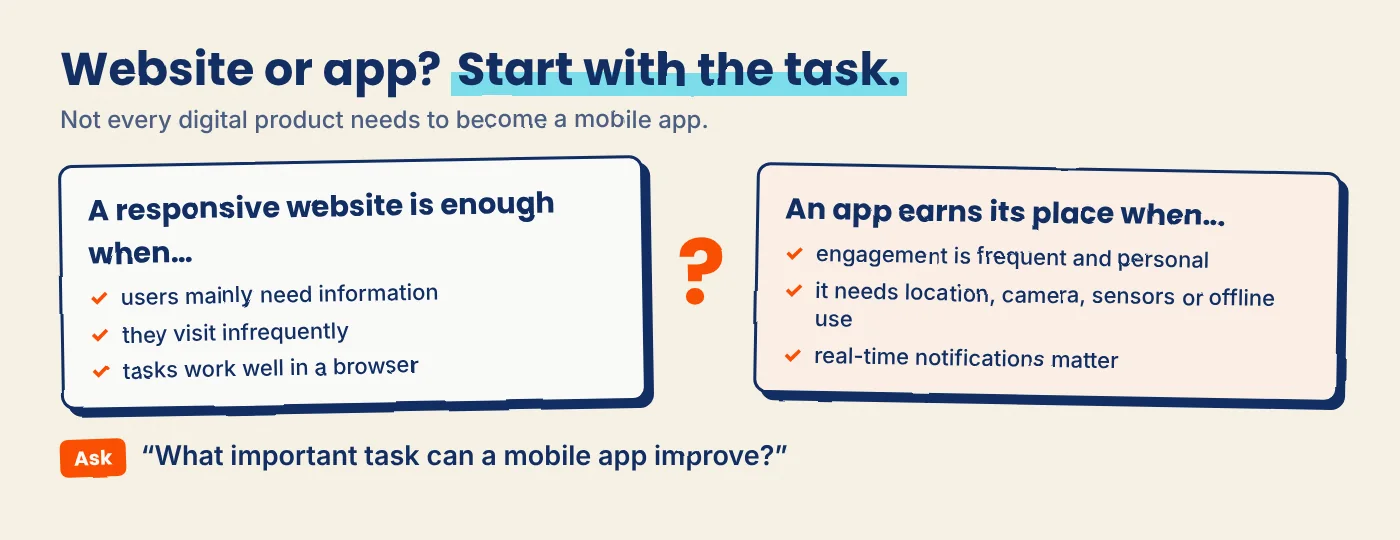
A mobile app becomes more compelling when the experience benefits from frequent engagement, personalized access, or capabilities closely tied to the device itself:
- Customers who regularly make purchases, manage accounts, access personalized information, or need real-time notifications
- Experiences that depend on location, cameras, sensors, or offline access
For internal operations, mobile applications support employees working outside a traditional office, such as field service teams, logistics providers, healthcare professionals, and sales representatives who need information and workflows while traveling or on-site.
The business case should focus on the value created, not the technology being used. The right starting question isn't "What features should our app have?" but "What important task or experience can a mobile application improve?"
That distinction prevents a common failure mode: investing heavily in functionality before validating whether the product solves a meaningful user or business need.
What Do Mobile App Development Services Include?
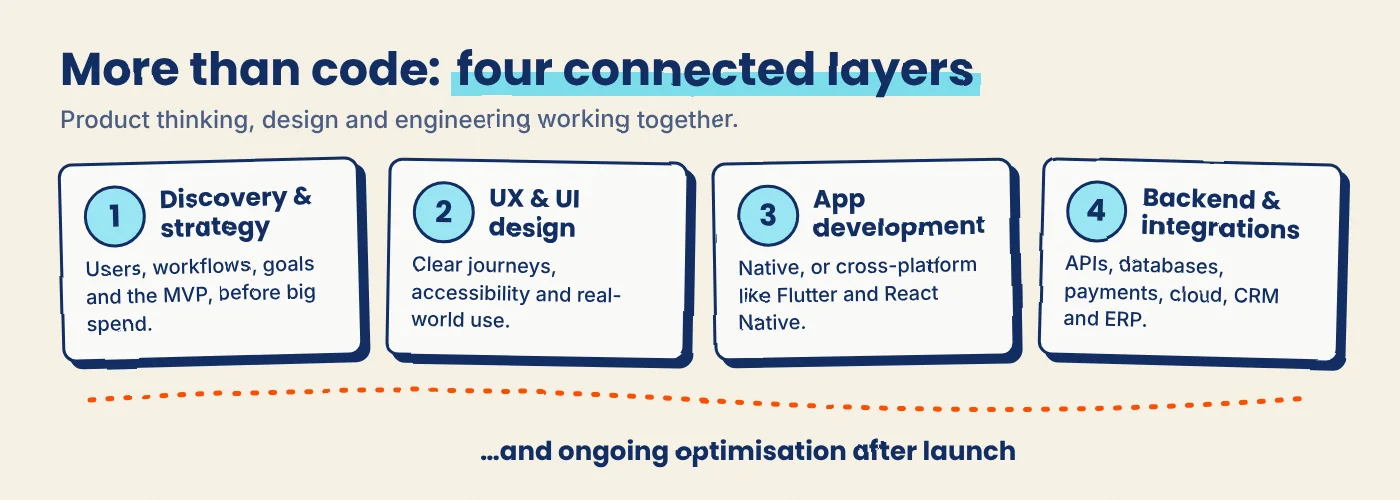
Professional mobile app development services should extend beyond writing code. A successful product requires product thinking, design, engineering, and ongoing optimisation working together, and most substantial projects move through several connected stages.
Product Discovery and Strategy
Discovery converts a broad idea into a clearly defined product by understanding target users, mapping existing workflows, identifying business objectives, analysing competing solutions and determining what belongs in the minimum viable product. The objective isn't the longest possible feature list; it's reducing uncertainty before significant development resources are committed.
UX and UI Design
Effective mobile design is about more than visual appearance. The application needs to help users understand what they can do, navigate efficiently, and complete important tasks without unnecessary friction, which requires attention to user journeys, information hierarchy, accessibility, platform conventions, and the real environments in which people use mobile devices.
Someone using an app while travelling, working outdoors or trying to finish a task quickly interacts with a product very differently than someone at a desktop in an office, and UX design should account for that reality.
Mobile App Development
The development approach depends on product requirements. Businesses may choose native development for iOS and Android, or a cross-platform framework such as Flutter or React Native to share a substantial portion of the codebase across both. Neither approach is automatically better: native development suits products that need highly optimised performance, deep access to device capabilities or platform-specific functionality. In contrast, cross-platform development reduces duplicated effort when a business needs to support both major platforms efficiently.
Backend Development and Integrations
The mobile interface is often just one layer of the overall product. Behind it, there may be authentication systems, databases, APIs, payment processing, cloud infrastructure, analytics platforms, CRM or ERP integrations, and administrative portals, one reason app development costs vary so significantly between projects.
Two applications with a similar number of screens can require completely different levels of engineering: a relatively simple interface connected to complex enterprise systems may involve considerably more technical work than a visually sophisticated app with limited backend functionality. A strong technical approach considers the entire ecosystem, not just the mobile interface.
How Does the Mobile App Development Process Work?
Every project differs, but a structured process usually moves from product definition toward progressively more detailed implementation.
- Discovery and planning: clarify the business problem, users, and initial scope.
- UX and UI design: while the technical architecture, mobile technology, backend services, integrations, security, and cloud infrastructure are established in parallel.
- Staged development: build in manageable stages rather than one large, opaque build.
- Quality assurance throughout: functional, integration, performance, security, accessibility and device compatibility testing as needed.
- Beta testing and deployment: release through the Apple App Store and Google Play.
- Learn and improve: use analytics, feedback, support requests, and performance data to guide the next release.
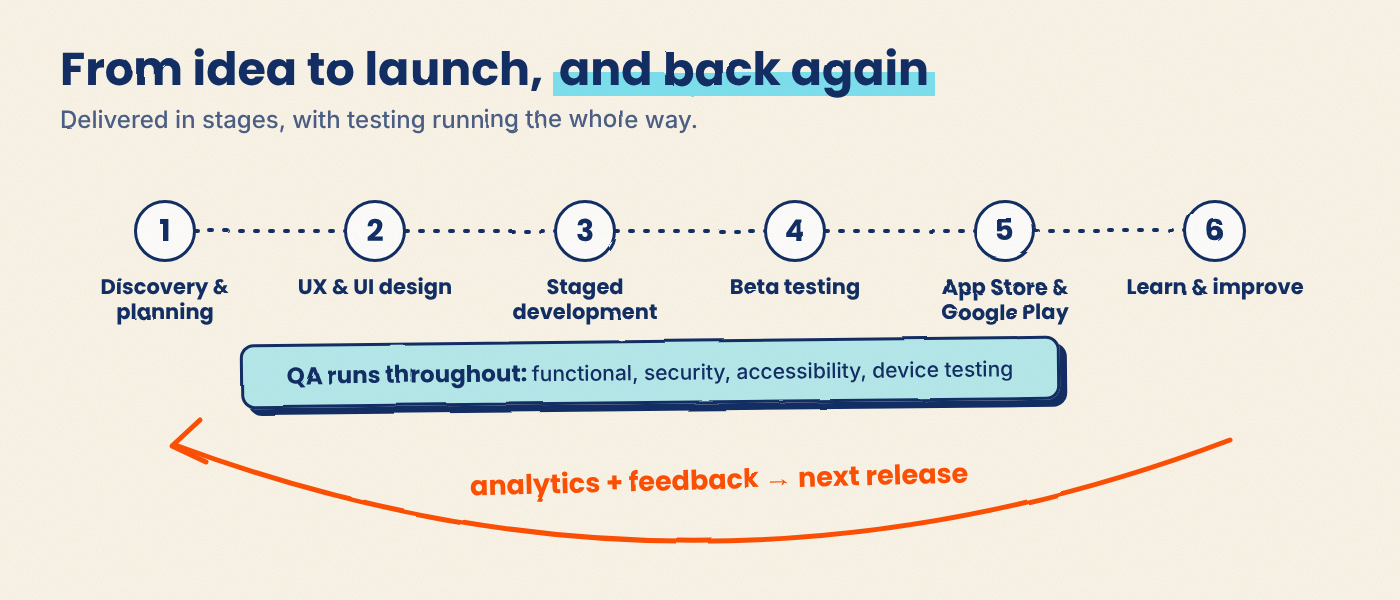
Development is generally more effective delivered in manageable stages, since staged delivery makes it easier to test assumptions, catch technical issues and refine priorities as the project progresses. Quality assurance should run throughout development rather than arriving as a final activity before launch.
Launch isn't the final stage. Once real users start interacting with the application, their behaviour surfaces information that wasn't available during planning; analytics, customer feedback, support requests, and performance data all feed forward into future product decisions.
Native vs Cross-Platform Development: Which Is Right for Your App?
The choice between native and cross-platform development should follow the product rather than a fixed preference. Native applications, built specifically for one operating system, offer more flexibility when an app requires advanced performance or deep integration with platform-specific functionality. Cross-platform development lets teams share a significant amount of code across iOS and Android, which for many products means faster development and simpler maintenance.
| Native | Cross-platform | |
|---|---|---|
| Built for | One operating system at a time | iOS and Android from a shared codebase (for example Flutter or React Native) |
| Strongest when | The app needs advanced performance or deep device and platform-specific capabilities | A business needs to support both major platforms efficiently |
| Typical benefit | Flexibility for specialised functionality | Faster development and simpler maintenance |
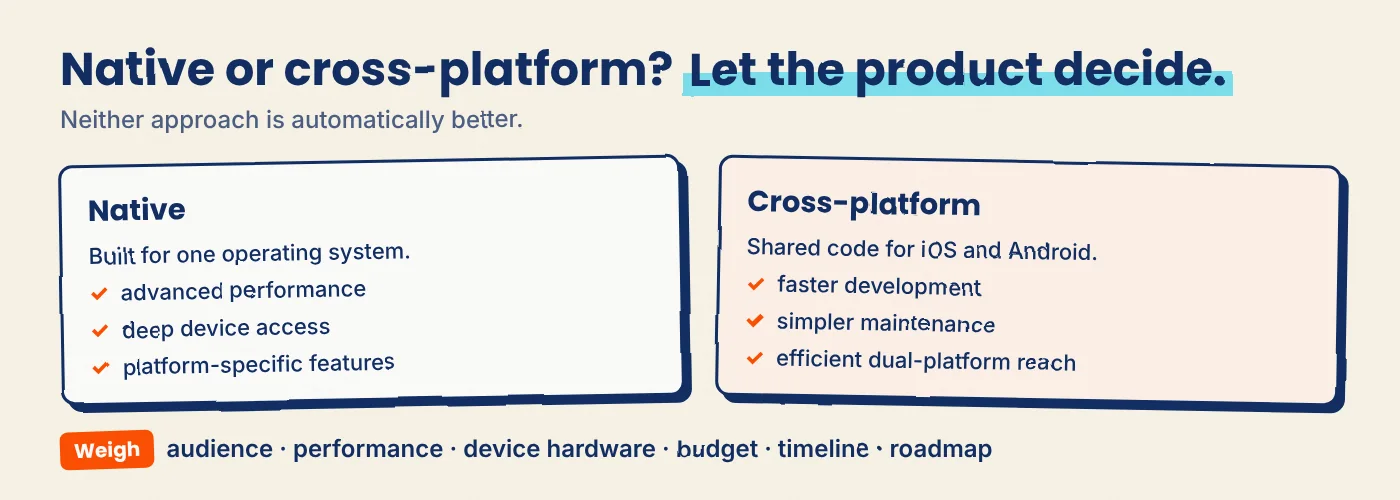
The decision should weigh the target audience, performance requirements, reliance on device hardware, budget, development timeline, and future roadmap. A consumer application that needs to reach both iOS and Android users quickly often benefits from a cross-platform approach; a highly specialised application that depends heavily on advanced native capabilities may need a different architecture. Choosing a framework before understanding the product tends to force unnecessary compromises later in development.
How Much Does Mobile App Development Cost in Australia?
There's no meaningful fixed price for developing a mobile application. Generic cost ranges are often misleading because they classify apps as "simple" or "complex" without explaining what those labels involve.
Cost is shaped by the scope of the product, the number and complexity of user workflows, the platforms supported, backend requirements, third-party integrations, security needs and testing requirements. AI functionality, real-time features, payment systems, multiple user roles and enterprise integrations can all add to the technical scope.
A more useful way to evaluate cost is to understand the assumptions behind an estimate.
| Product type | What it typically includes |
|---|---|
| Focused MVP | One or two essential user journeys and a limited set of integrations |
| Larger product | Account management, multiple user types, advanced backend functionality, and analytics |
| Enterprise application | Complex permissions, legacy system integrations, stronger security controls, and extensive administrative capabilities |
The development proposal should make these differences explicit: what's included, what assumptions were made, and which costs continue after launch. Cloud infrastructure, third-party software, payment services, and AI model usage all create ongoing operational expenses.
The lowest initial quote isn't always the lowest long-term investment. An application that requires significant rework, lacks documentation, or becomes difficult to maintain creates costs long after the original project has ended.
How Long Does It Take to Develop a Mobile App?
Timeline depends largely on the same factors that drive cost. A focused MVP develops much faster than a product with multiple user roles, complex integrations, and enterprise-level security requirements. Development itself, though, is often not the main source of delay; projects slow down because requirements keep changing, key business decisions remain unresolved, or too much functionality gets crammed into the first release.
A realistic delivery plan accounts for discovery, design, development, testing, and release preparation, rather than presenting the whole project as a single development timeline. Defining the MVP carefully matters here: the first release doesn't need to solve every future problem, only to deliver enough value that the business can learn from real-world usage, and that learning should guide future investment.
How Is AI Changing Mobile App Development?
AI is changing both the products businesses build and how software teams build them. Within an application, AI can support intelligent search, personalised recommendations, document processing, image recognition, conversational experiences and workflow automation, but it shouldn't be added simply because it's a prominent trend. The more useful question is whether it improves the user's ability to understand information, make decisions or complete a task.
AI-enabled applications require careful attention to accuracy, privacy, reliability and cost. Businesses need to understand what information is being fed to an AI system, how outputs are evaluated, and what happens when the system produces an incorrect result. These considerations matter even more when an application processes personal information or supports decisions that could significantly affect users.
AI is also changing software delivery itself. Development teams increasingly use AI-assisted tools to accelerate prototyping, coding, documentation and test creation, which can meaningfully improve productivity, but it doesn't remove the need for experienced product, engineering and QA professionals. Generated code still needs review, security still needs to be considered, and product decisions still require an understanding of users and business objectives.
The value of AI-assisted development isn't producing more code; it's reducing unnecessary effort so teams can spend more time on the decisions that move the product forward.
How to Choose the Right Mobile App Development Company
Selecting a mobile app development company should involve more than reviewing a portfolio. Visual design demonstrates creative capability, but it doesn't reveal how a company approaches product strategy, technical architecture, security, or long-term maintenance.
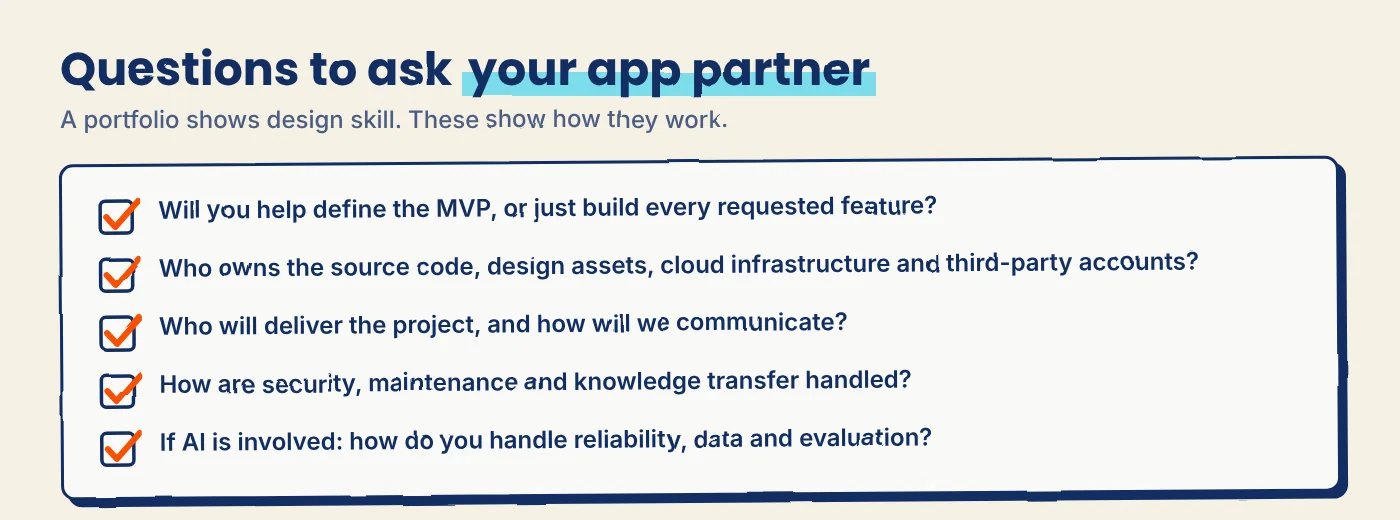
A strong development partner helps define the MVP rather than simply agreeing to build every requested feature and stays transparent about technical decisions and how the application will integrate with existing systems. Businesses should understand:
- Who owns the source code, design assets, cloud infrastructure and third-party accounts associated with the application
- Who will deliver the project, and how communication will work throughout development
- How security, maintenance and knowledge transfer will be handled, ideally discussed before the engagement begins
- If AI is part of the product, how the team approaches model reliability, data handling, evaluation and changes to third-party AI services
The right partner discusses these issues clearly rather than treating development as a simple matter of converting a feature list into code.
Building an App with Sigma Solve
The future of mobile app development won't be defined by a single framework or technology trend. AI-native experiences, multimodal interaction, on-device intelligence, connected devices and more adaptive interfaces will keep shaping how businesses design mobile products, while privacy expectations, accessibility requirements, security risks, and platform changes will require applications to evolve continuously.
The most important decision still comes before technology selection: what problem is the product solving, and what's the most effective way to solve it? Once the business objective, users, and essential workflows are clear, the development strategy can be built around them. Technology, architecture, and the feature roadmap should support that foundation, not become the starting point for the project.
For businesses seeking mobile app development services in Australia, the strongest approach is to begin with product discovery, define a realistic MVP, and build an application that can adapt as user needs and business requirements change.
At Sigma Solve, mobile app development begins with understanding the product challenge rather than implementing a predetermined feature list. From product discovery and UX design to development, integrations, AI capabilities, and long-term maintenance, the goal is to build mobile solutions around meaningful business and user outcomes.
Planning an App? Start With a Product Discovery Call
Whether you're planning a new mobile application or evaluating how to modernise an existing product, the fastest way to avoid expensive rework is to get the first decisions right. Talk to our experts and walk away with:
- A clear view of whether an app is the right solution for your problem
- A realistic MVP scope for your first release
- The development approach, native or cross-platform, that fits your product and roadmap
Reach out and we'll provide you with the best solution for your business.