
Real-Time Tracking in Logistics: Why Tracking Data Alone Is No Longer Enough
Milind Shah · 10/4/2024 · 9 min read

Real-time tracking has become a standard capability across modern logistics. Shipments can be monitored through carrier integrations, telematics devices, driver applications, APIs, and visibility platforms, providing logistics teams with location and status updates that would have been difficult to obtain just a few years ago.
Yet more tracking data hasn't eliminated one of logistics' oldest problems: discovering an issue only after the available options have narrowed.
A shipment may be visible throughout its journey and still miss its delivery appointment. An ETA may be highly accurate for the shipments being tracked while a meaningful part of the network remains outside that coverage. An operations team may receive an alert about a delay but still need to search across several systems to understand which customer is affected, whether the delay has any serious consequence, and what can realistically be done about it.
That's the gap between tracking and useful visibility, and it's what this piece is about.
The question is no longer simply whether a company can track its shipments in real time. It's whether the information it receives gives the business enough time and context to respond when something changes.
Why Real-Time Tracking Doesn't Always Provide Complete Logistics Visibility
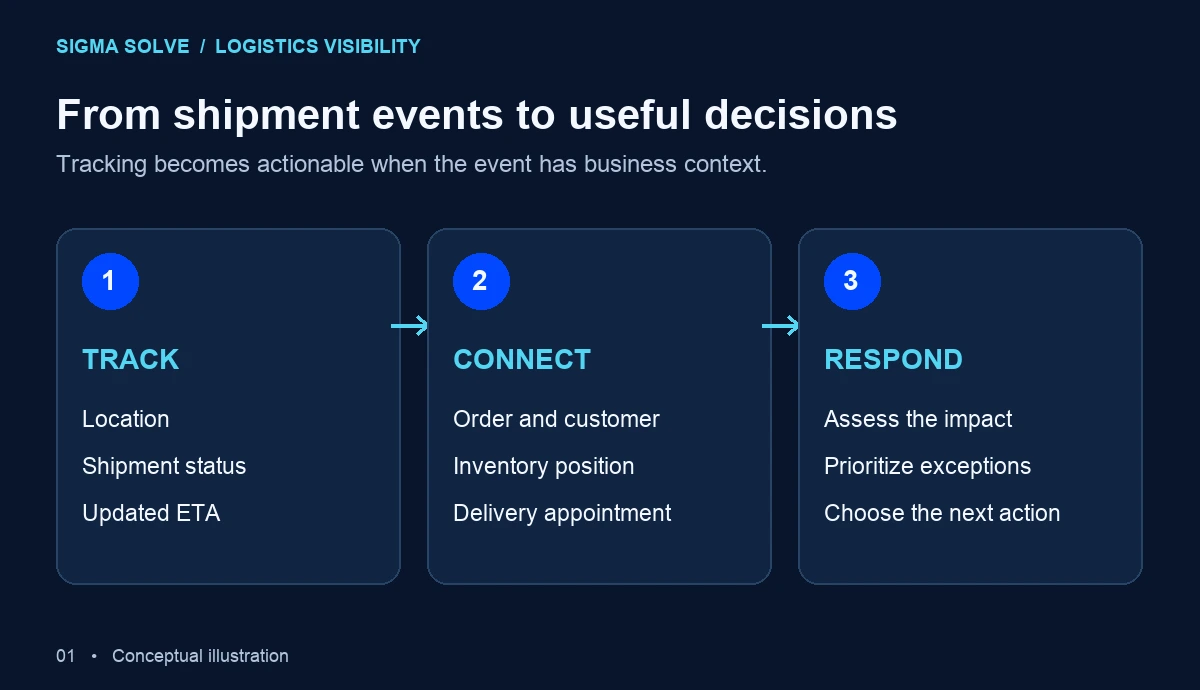
Tracking tells a company where a shipment is and, depending on the available data, what stage of its journey it has reached. That information is essential, but it's only one part of the operational picture.
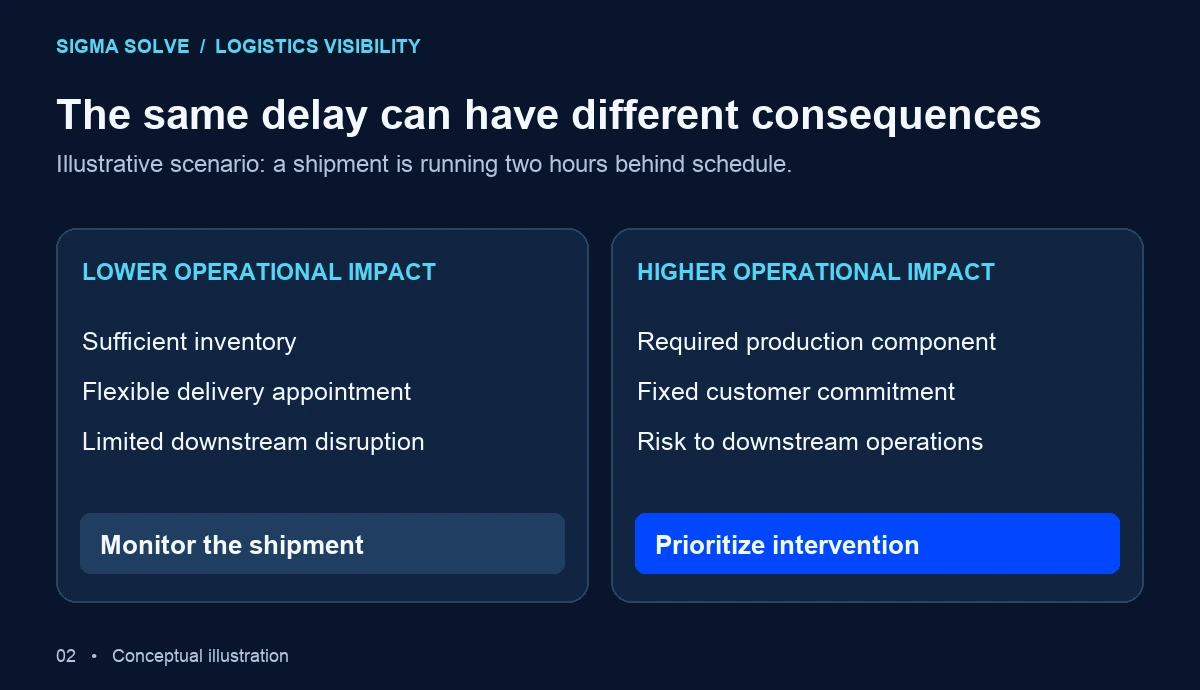
Consider a shipment running two hours behind schedule. The location data may accurately show where the vehicle is, and the system may correctly update its estimated arrival time. Neither piece of information explains whether the delay will cause a missed delivery appointment, disrupt a warehouse schedule, affect inventory availability, or create a service issue for an important customer.
Those questions require additional context: connecting the transportation event to the order, delivery commitment, customer, inventory position, or appointment schedule it affects. Without those connections, a visibility platform can show that something has changed without explaining why the change matters.
This distinction matters more as transportation networks grow more complex. Gartner's definition of real-time transportation visibility platforms includes basic shipment tracking, road transport visibility, messaging and alerts, and predictive ETAs as mandatory capabilities. In other words, the industry itself has moved past the assumption that displaying a shipment's location is enough.
How Coverage Gaps Create Blind Spots
A company can't act on information it doesn't receive.
Tracking coverage varies widely across carriers, transportation modes, geographic regions, and partner networks. A logistics organization may receive detailed, frequent updates for shipments moving through certain carriers or domestic road networks, while receiving limited information for ocean freight, rail movements, international shipments, or smaller transportation partners, a gap easily masked by broad claims of "real-time visibility."
Logistics operations are judged by how well they handle exceptions, not by how smoothly they manage shipments that were already easy to track. So coverage should be evaluated alongside accuracy: a highly accurate ETA is valuable only for shipments the system has enough information to predict in the first place.
For logistics leaders, the more useful question isn't "How many shipments can we track?" It's "Where are the gaps in our network, and what happens when an important shipment falls into one of them?"
Why Data Quality Matters as Much as Coverage
Coverage determines how much of the network a company can see. Data quality determines whether the information it sees can be trusted.
A shipment update can arrive in real time and still create confusion if the system can't reliably connect it to the correct shipment or order. Carrier systems use different identifiers. Status definitions don't always match across platforms. Events arrive late, appear more than once, or contain incomplete information. Multiple systems may show different versions of the same shipment's expected arrival time.
This creates a hidden layer of work: when information can't be trusted immediately, employees have to investigate it, comparing updates across systems, checking carrier portals, and contacting partners before deciding whether a problem requires action. Adding more data sources doesn't automatically fix this. Without a reliable way to validate, match, and organize information, a larger volume of updates just creates a larger volume of uncertainty.
A visibility strategy shouldn't begin and end with selecting a platform. Companies also need to understand how shipment information moves across their existing systems, where it becomes incomplete or inconsistent, and how transportation events connect to the business records that give those events meaning.
What Makes a Real-Time ETA Reliable
Estimated arrival time is one of the most useful outputs of real-time tracking, because it can flag early that a delivery may not occur as planned. But an ETA isn't simply accurate or inaccurate; its usefulness depends on the availability of current tracking data, the quality of the underlying shipment data, how frequently new events arrive, the transportation mode involved, and whether the prediction accounts for changing conditions.
Modern visibility platforms increasingly generate predictive ETAs using live and historical transit data plus external factors like traffic and weather, rather than relying only on carrier-provided estimates; Gartner lists predictive ETA as a mandatory capability for this market.
Accuracy is only half the equation; timing is the other half. A prediction that flags a likely delay ten minutes before a delivery appointment leaves little room to respond. The same prediction, available several hours earlier, gives the team time to contact the customer, adjust the appointment, or change downstream plans.
Companies should also examine where ETA performance is strongest and where it degrades. An average accuracy figure can conceal real differences between carriers, regions, modes, and coverage levels. The objective isn't a more precise arrival time for its own sake; it's identifying potential problems early enough for the business to influence the outcome.
Why More Tracking Alerts Can Mean More Operational Work
As tracking systems collect more information, they also generate more exceptions: a route deviation, a threshold crossing, a changed ETA, a delay flag. Across a large network, these can add up to hundreds or thousands of notifications a day, and not every exception deserves the same response.
A one-hour delay on one shipment may have little consequence; the same delay on another could mean a missed production schedule, a customer penalty, or added transportation cost. A system that treats both events identically still leaves the operations team to figure out which one matters, opening the TMS, checking the ERP, reviewing a warehouse schedule, calling the carrier, before deciding whether to intervene.
Visibility becomes more valuable when it reduces that investigation rather than just flagging that something changed: which shipments are at risk, what the likely consequence is, who's affected, how much time remains to respond. That shift from detecting events to understanding their significance is where visibility starts supporting decisions rather than just reporting activity.
Why Shipment Events Need Business Context
A transportation event has no fixed importance on its own. The same two-hour delay can be a non-issue for one shipment and highly disruptive for another, depending on what it contains, who's receiving it, when it's needed, and what else depends on its arrival. A delayed inbound shipment may not matter if the warehouse has sufficient inventory, or it could halt a production line if it's carrying a required component. A late delivery might be immaterial for one customer and an SLA violation for another.
This is why transportation visibility can't operate in isolation. Shipment events need to connect with the systems holding the surrounding context: TMS, WMS, ERP, customer platforms, inventory systems, not necessarily to replace those systems, but to make the information between them easier to use. When something meaningful happens, the people responsible shouldn't have to reconstruct the situation manually; they should be able to see what changed, who's affected, and what options remain while there's still time to act.
This gets harder as supply chains get more complex. McKinsey's December 2025 supply chain survey found 95% of leaders have visibility into tier-one supplier risk, but only 42% have visibility extending to tier two or beyond, a good proxy for how much visibility erodes with each additional layer of a network. Transportation faces the same dynamic: visibility gets harder as the number of systems, partners, and dependencies grows.
Where AI Actually Helps and Where It Doesn't
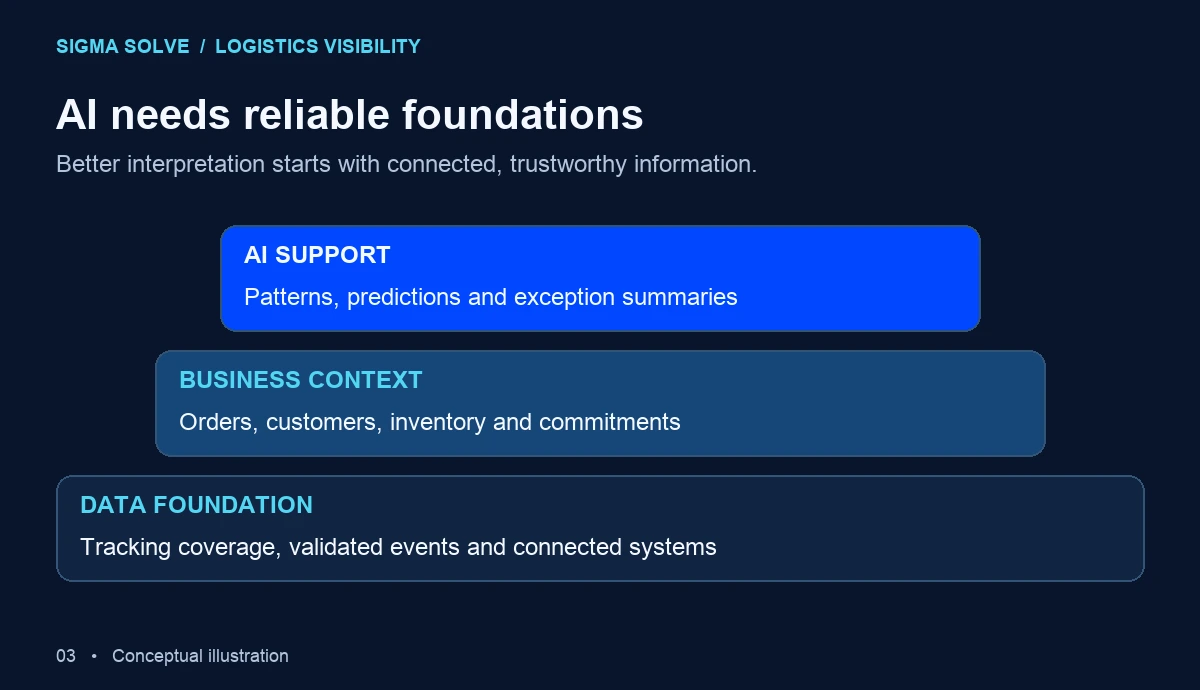
AI has a growing role in logistics visibility, though its value is often overstated. Its best use isn't producing another prediction or another summary; it's helping operations teams process a volume of information that would otherwise take significant manual effort.
A large network can generate thousands of updates a day. AI can help spot unusual patterns, assess changing conditions, sharpen predictions, and pull together information from different systems when an exception occurs. If a high-priority shipment looks likely to miss its delivery window, an AI-supported system could gather the latest transportation data, identify the affected order and customer commitment, summarize the reason for the change, and surface the relevant constraints before a planner starts investigating, with the planner still making the call, just with less time spent gathering basics. AI can also help prioritize exceptions, distinguishing a routine delay from one likely to carry real operational or financial consequence.
What AI can't do is compensate for poor tracking coverage or unreliable data. If a meaningful part of the network stays invisible, or the underlying data is inconsistent, any prediction or recommendation inherits those same limitations, and broader AI-adoption data backs up the gap between interest and execution: McKinsey's 2025 State of AI survey found 88% of organizations use AI in at least one business function, but only 7% report it fully scaled across the enterprise. Visibility-specific AI use cases may follow a similar pattern, although the survey does not establish this directly, meaning the technology can improve how logistics teams interpret and use information, but it doesn't remove the need for reliable data and connected systems underneath it.
Moving From Real-Time Tracking to Faster Operational Decisions
Real-time tracking solved the problem of making transportation events visible. The next challenge is making sure that visibility leads to better decisions, which means looking past the number of connected carriers, devices, or shipment updates and asking how well information supports daily operations:
- How much of the transportation network can be tracked?
- Where do significant coverage gaps remain?
- How reliable is the information from different sources?
- How quickly can a likely delay be identified?
- Can transportation events relate to customers, orders, inventory, and other business processes?
- Which exceptions genuinely require intervention?
- When an important issue is identified, does the organization have enough time and information to respond?
The answers differ by business because transportation networks vary in geographic reach, carrier mix, modes, systems, and operational priorities, which is why the technology strategy should follow the operating requirements, not the other way around. For some companies, an established visibility platform with broad carrier connectivity covers most of the need. For others, the harder problem is integrating fragmented systems, improving data quality, applying business rules to transportation events, or connecting visibility data with existing workflows.
The goal isn't collecting more tracking data for its own sake. It's shortening the distance between an event occurring and the business understanding what that event means.
Build a Logistics Visibility Strategy Around Your Actual Operations
Every logistics network has its own mix of carriers, systems, transportation modes, workflows, and data gaps. Sigma Solve helps organizations connect fragmented logistics data, integrate transportation information with existing business systems, and build technology solutions around the decisions their operations actually need to make.
Talk to our team to explore how better-connected logistics data can turn real-time shipment events into faster, more informed action.