
Microsoft Fabric vs. Snowflake vs. Databricks
Shivam B · 9/18/2026 · 10 min read

Choosing a modern data platform used to be straightforward: a cloud data warehouse for analytics, a data lake for large-scale processing, and a set of tools assembled around them. That model is disappearing.
Microsoft Fabric, Snowflake, and Databricks have all expanded well beyond their original identities. Fabric now unifies data engineering, integration, warehousing, real-time intelligence, data science, Power BI, and AI within a single SaaS environment. Snowflake has evolved from a cloud data warehouse into an AI Data Cloud spanning data engineering, applications, unstructured data, Iceberg, Cortex AI, and agentic workloads. Databricks has moved from a Spark-centric lakehouse to a platform that covers data engineering, SQL analytics, governance, machine learning, generative AI, and AI agents.
That makes the decision more important and harder. The wrong question is "which platform has more features?" The right one is: which platform fits the way your organization actually creates, governs, analyzes, and uses data? Your existing cloud environment, BI stack, engineering skills, AI ambitions, governance requirements, and cost model matter as much as raw capability. Let's deep dive into the blog and understand which model is best for your business.
At a Glance
| Decision factor | Microsoft Fabric | Snowflake | Databricks |
|---|---|---|---|
| Core positioning | Unified analytics and data platform | Cloud data and AI platform | Lakehouse and data/AI platform |
| Architecture | OneLake + integrated Fabric workloads | Managed platform, separated storage/compute/services | Lakehouse built on Delta Lake, expanding to open formats |
| Strongest fit | Microsoft-centric enterprises, BI-led analytics | SQL analytics, governed sharing, multi-cloud | Data engineering, ML, AI, complex workloads |
| BI | Exceptional with Power BI | Strong via major BI tools | Strong via Databricks SQL and BI integrations |
| Data engineering | Strong | Strong | Excellent |
| Advanced ML/AI | Strong, expanding | Strong, rapidly expanding | Excellent |
| Streaming / real-time | Strong | Strong for native workloads | Excellent |
| Governance | Fabric + Microsoft ecosystem | Snowflake governance + Horizon | Unity Catalog |
| Data format strategy | Delta/Parquet + OneLake; growing Iceberg | Snowflake tables + Iceberg | Delta native; expanding Iceberg |
| Multi-cloud | Azure-centric | AWS, Azure, GCP | AWS, Azure, GCP |
| Pricing model | Capacity-based, plus consumption options | Consumption-based credits | Consumption-based DBUs + cloud infrastructure |
| Operational complexity | Low to moderate | Low | Moderate to high |
| Best reason to choose it | Reduce fragmentation across Microsoft analytics | Simplify governed SQL analytics at scale | Build a flexible engineering, ML, and AI platform |
The table is a useful starting point, but it hides the part that matters most: why each platform feels fundamentally different once you're operating it at scale.
Three Different Starting Points
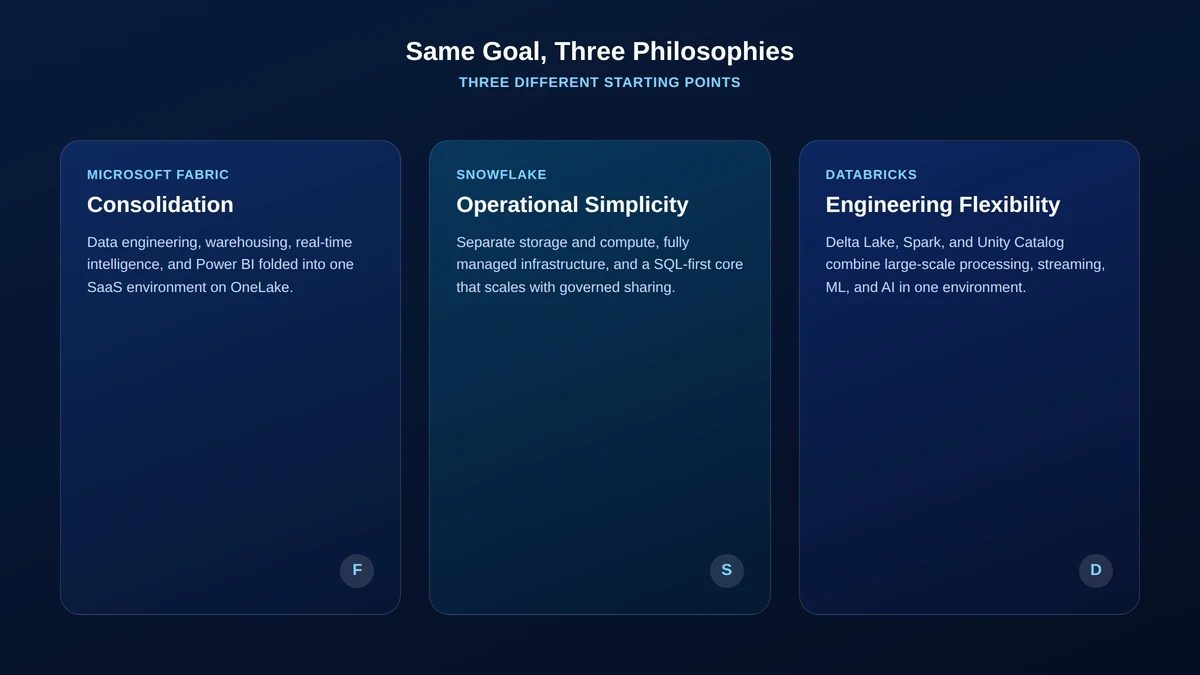
Fabric was built around consolidation. Rather than adding another warehouse or lakehouse, Microsoft is folding data engineering, integration, warehousing, real-time intelligence, data science, AI, and Power BI into one SaaS environment, with OneLake as the common data layer, reducing the number of separate services teams have to stitch together.
Snowflake started by making cloud warehousing easier to operate: separate storage and compute, and let Snowflake manage the infrastructure. It has since expanded into data engineering, unstructured data, Iceberg, applications, and agentic AI, while keeping its SQL-first core.
Databricks grew out of data engineering and Apache Spark. Its lakehouse uses Delta Lake as the default storage layer and combines large-scale processing, streaming, SQL analytics, ML, and AI in one environment, with Unity Catalog extending governance across both data and AI assets.
In short: Fabric is optimizing for consolidation, Snowflake for operational simplicity at scale, and Databricks for engineering flexibility across data and AI. The boundaries are blurring, but these underlying philosophies still shape the day-to-day experience.
Microsoft Fabric: The Consolidation Play
Fabric's advantage isn't any single workload - it's that Data Factory, Data Engineering, Data Warehouse, Real-Time Intelligence, Data Science, and Power BI all operate over the same OneLake foundation, sharing data and artifacts without unnecessary duplication. For an organization already running Power BI, Microsoft 365, Azure, Entra ID, and Microsoft security tooling, that materially reduces the number of architectural boundaries teams have to cross. Fabric's lakehouse pairs Delta Lake storage with Spark and SQL access, so engineers and analysts work against the same data rather than maintaining separate copies per workload.
Where it's strong: Power BI integration is the clearest differentiator; Fabric brings analytical storage, engineering pipelines, and the semantic layer closer together than a BI tool sitting on top of an independent platform ever could. Fabric is also advancing quickly on AI-driven analytics: AI Functions apply LLM-powered transformations to pandas and PySpark data, MLflow 3 tracks ML and generative-AI workloads, and Fabric data agents are gaining the ability to route questions across lakehouses, warehouses, semantic models, and KQL databases.
Where it's less obvious: if your teams are deeply invested in AWS or GCP, run a large Spark engineering organization, or need maximum flexibility in data and ML infrastructure, Databricks is likely a better fit. If the priority is a mature, cloud-neutral SQL analytics platform with sophisticated cross-cloud sharing, Snowflake can be more compelling. Fabric wins when consolidation itself is a strategic priority.
Snowflake: The Managed Data Platform Play
Snowflake's enduring advantage is simplicity. Its architecture separates storage, compute, and cloud services; virtual warehouses provide independent compute clusters, and Snowflake manages the underlying infrastructure and upgrades. That makes it attractive to organizations whose data platform mainly needs to serve large volumes of analytical queries reliably, without turning the organization into a platform-engineering shop. SQL stays central: a company can run a sophisticated data architecture without requiring every analyst to master Spark internals.
The bigger story in 2026 is AI. Cortex AI now covers text and image processing, document intelligence, search, RAG workloads, and agents. Cortex Agents combine structured data (via Cortex Analyst) with unstructured data (via Cortex Search) to run multi-step workflows inside Snowflake's governed environment. This is commercially significant: Snowflake reported 37% year-over-year product revenue growth in fiscal 2027's second quarter and raised its full-year outlook, citing AI as a major driver. Snowflake is no longer a platform you choose only for BI and warehousing; it's positioning itself as a governed data-and-AI control layer.
Its Iceberg support (managing Iceberg storage itself, or working with data in customer-controlled cloud storage) also complicates the old "Snowflake is a proprietary warehouse" framing, giving organizations more flexibility about which datasets are locked into Snowflake-managed tables.
Where it fits best: SQL-centric analytics, predictable operations, high concurrency, governed data access, cross-cloud deployment, data sharing, and increasingly, AI applications built close to governed enterprise data. It's less straightforward when workloads are dominated by heavy distributed engineering, advanced ML experimentation, or Spark-ecosystem-dependent pipelines.
Databricks: The Engineering and AI Powerhouse
Databricks is strongest when data engineering and ML are treated as core engineering disciplines rather than support functions for BI. Its foundation, Delta Lake, extends Parquet with a transaction log that adds ACID transactions, scalable metadata handling, and schema enforcement, supporting batch and streaming against the same data foundation. That matters when data isn't clean, static, or purely relational: application events, IoT streams, documents, customer interactions, transactional records, and ML features all need to be ingested, transformed, streamed, enriched, modeled, and served continuously. This is where Databricks tends to shine.
It's also become considerably easier to operate. Serverless compute now handles notebooks, jobs, and Lakeflow pipelines without customers provisioning underlying resources, and serverless SQL warehouses provide elastic compute with Photon, predictive I/O, and intelligent workload management, narrowing, though not closing, the operational gap with Snowflake.
Unity Catalog is now central, providing governance, access control, lineage, auditing, discovery, classification, quality monitoring across both managed and externally stored assets, and increasingly across models, AI applications, functions, and vector-search assets, not just tables. Databricks is also investing heavily in the operational side of AI: MLflow 3 covers experiment tracking, evaluation, observability, and deployment, and the platform supports building and deploying agents and serving models from providers including OpenAI and Anthropic.
Where it fits best: advanced data engineering, large-scale ETL/ELT, streaming, ML, generative AI, agents, complex or unstructured datasets, open lakehouse architectures, and sophisticated data/AI governance. The trade-off is that extracting full value generally requires stronger engineering maturity than the other two platforms demand.
Architecture Matters More Than Features
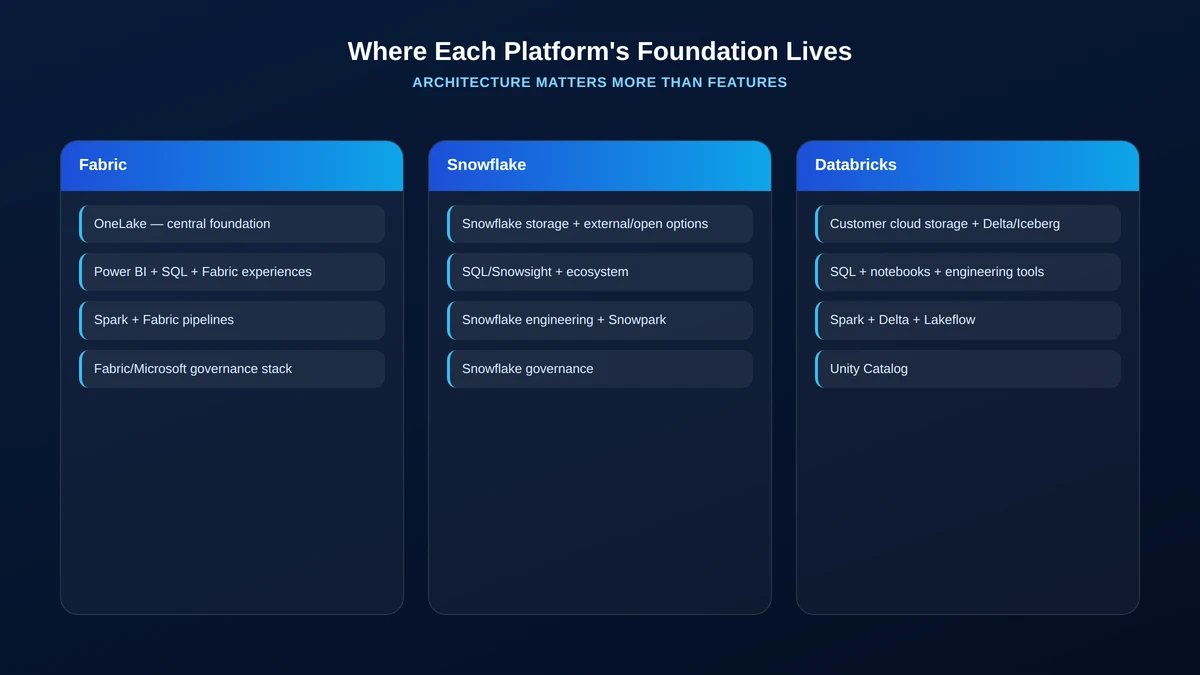
All three platforms can now ingest data, run SQL, support BI, work with AI, and support governance; counting checkmarks won't differentiate them. What matters is how each accomplishes those things and what that means for your organization:
| Architecture question | Fabric | Snowflake | Databricks |
|---|---|---|---|
| Central data foundation | OneLake | Snowflake storage + external/open options | Customer cloud storage + Delta/Iceberg |
| Primary analytical interface | Power BI + SQL + Fabric experiences | SQL/Snowsight + ecosystem | SQL + notebooks + engineering tools |
| Engineering foundation | Spark + Fabric pipelines | Snowflake engineering + Snowpark | Spark + Delta + Lakeflow |
| Open table formats | Delta/Parquet; growing Iceberg | Strong Iceberg support | Delta native; expanding Iceberg |
| Data sharing | Microsoft ecosystem | Major strength | Strong, increasingly open |
| AI development | Fabric AI + Microsoft ecosystem | Cortex | Databricks AI/ML ecosystem |
| Governance center | Fabric/Microsoft governance stack | Snowflake governance | Unity Catalog |
The clearest way to use this table: for data engineering, all three handle standard ELT, but the gap widens with complexity. Databricks has the strongest native story for extensive Spark pipelines, streaming, and feature engineering; Fabric is the natural choice when engineering needs to sit close to Power BI and Microsoft's data services; Snowflake wins when engineering is heavily SQL-oriented and a managed environment beats infrastructure flexibility. The question worth asking isn't "does it support data engineering" (all do) but what kind of data engineering will we be doing three years from now.
AI and Machine Learning: A Different Split
"Which platform has the best AI" is the wrong question. The right one is whether you're primarily building models, embedding AI into analytics, or putting agents directly on governed business data, because each platform answers a different version of that question.
Databricks is strongest for significant experimentation, custom ML pipelines, feature engineering, evaluation, and production deployment, backed by MLflow, Unity Catalog, and model serving. Snowflake is increasingly strong for organizations that want AI to operate directly against governed enterprise data without building a separate AI data layer; Cortex AI Functions, Search, and Agents bring AI closer to SQL, structured data, and documents. Fabric's advantage is different again: it combines data, analytics, Power BI, and Microsoft's broader AI ecosystem, making it useful where business users need natural-language access to enterprise data.
Cost: There's No Universal Answer
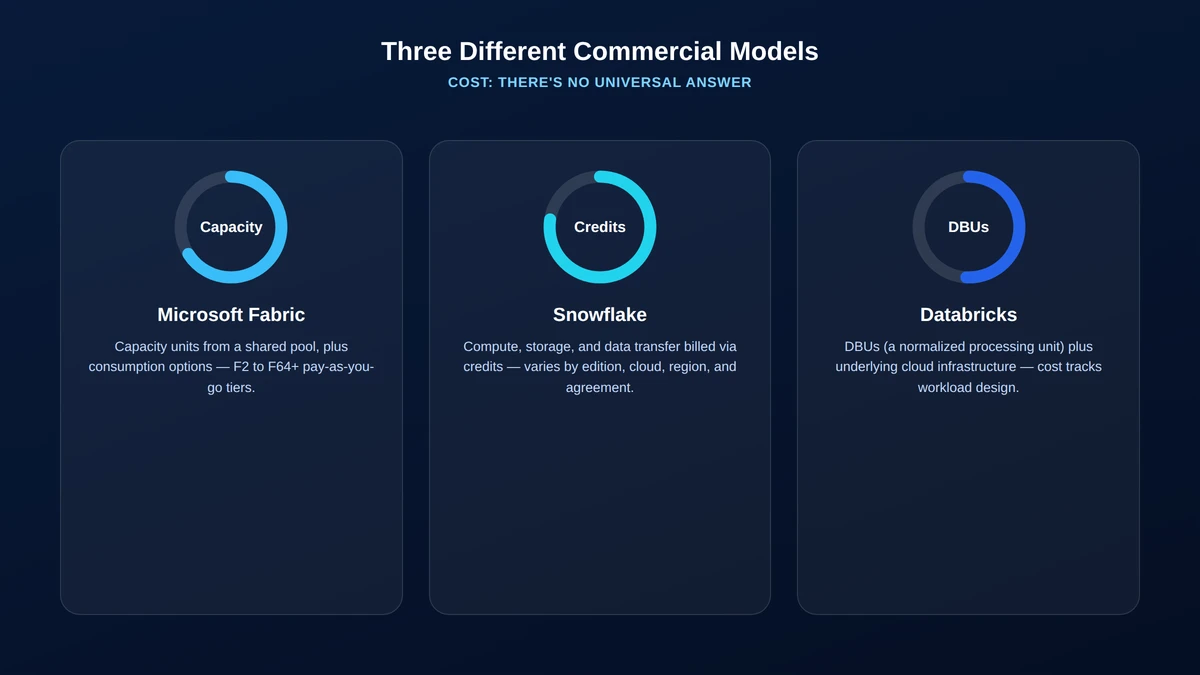
Comparisons of "which is cheapest" are usually unreliable, because the commercial models aren't comparable. Fabric uses capacity units from a shared pool; current US pricing shows F2 at $262.80/month and F64 at $8,409.60/month on pay-as-you-go, before contract-specific pricing and reservations. Snowflake charges for compute, storage, and data transfer via credits, varying by edition, cloud, region, and agreement. Databricks charges in DBUs (a normalized processing unit) plus underlying cloud infrastructure, so cost depends heavily on workload design and utilization.
Comparing a Fabric F32 capacity to "a Snowflake medium warehouse" to "a Databricks cluster" and declaring a winner is close to meaningless. A serious TCO analysis needs to include compute, storage, networking, BI licensing, AI consumption, governance, engineering labor, migration, and platform operations; the last two are the ones most often left out. A platform that costs 15% more in infrastructure but lets you eliminate several managed services, or cuts engineering effort substantially, can easily have the lower total cost. Conversely, a platform that looks cheap in a proof of concept can get expensive fast as workloads, concurrency, and AI consumption scale.
The Hidden Cost: Your Existing Stack
This is arguably the most important factor in the decision, and the one platform comparisons most often skip.
A company running Microsoft 365, Power BI, Azure, Entra ID, and Microsoft security and governance tooling, with teams experienced in T-SQL and Power BI, gets value from Fabric that isn't captured in its sticker price; it's the architectural friction the organization eliminates.
A company on AWS with a mature Spark engineering team, Kafka-based streaming, MLflow workflows, deep Python development, and existing Delta Lake infrastructure will likely find a much better organizational fit with Databricks.
A company operating across multiple clouds, with a large SQL-centric analytics organization, strong data-sharing requirements, and a preference for managed infrastructure, will likely find Snowflake the better fit.
Platform fit beats feature count, and fit is largely determined by the stack, skills, and habits you already have.
Multi-Cloud, Operations, and Governance
- Multi-cloud: Snowflake and Databricks operate across AWS, Azure, and Google Cloud; Fabric is tied to Microsoft's ecosystem. That's not a weakness if Azure is already your center of gravity, but if your strategy explicitly requires portability across clouds, Snowflake or Databricks are the more natural foundation.
- Operational simplicity: Snowflake's fully managed architecture abstracts away provisioning, upgrades, and most tuning. Fabric's integrated SaaS model spares teams from assembling a separate warehouse, lake, BI layer, and orchestrator. Databricks has narrowed the gap with serverless compute and SQL warehouses, but its flexibility means more architectural decisions land on your engineering team. As a rule: the more flexibility you need, the more engineering maturity you should expect to bring.
- Governance: modern platforms need to govern not just tables but documents, models, agents, sensitive data, lineage, usage, and AI cost, and all three now do this. Unity Catalog is built around this broader definition; Snowflake extends its existing security and privilege model to Cortex Agents; Fabric leans on Microsoft's broader governance and security ecosystem. The useful question isn't "does it have governance"; it's whether your governance model can cover data, analytics, and AI without creating another fragmented control layer.
What If You Need More Than One?
You don't always have to choose a single platform. Large enterprises routinely run heterogeneous data environments because different business units and workloads have different needs: Fabric for enterprise BI and Power BI, Databricks for advanced ML and engineering, and Snowflake for governed analytics and sharing. In that case, the question changes from "which platform replaces everything" to "where should each platform sit, and what data crosses the boundary." That can be a genuinely rational architecture, but only with clear ownership of data products, governance, lineage, interoperability, and cost controls. Without that discipline, a multi-platform strategy just recreates the fragmentation it was meant to solve.
Test the Workloads, Not the Marketing
A proof of concept shouldn't ask vendors to run their best-case demo. Build a representative workload portfolio instead:
- BI performance: Real production-scale data and representative Power BI/Tableau/SQL workloads. Measure query latency, concurrency, dashboard refresh time, capacity utilization, and user experience.
- Data engineering: Realistic ingestion and transformation pipelines. Measure pipeline duration, failure recovery, schema evolution, incremental processing, and engineering effort.
- AI workload: A real business problem, not a generic chatbot demo. Measure retrieval quality, latency, model flexibility, governance, observability, and token/compute consumption.
- Governance: Implement actual enterprise requirements: row- and column-level security, sensitive-data classification, lineage, auditability, cross-team access, AI asset governance.
- Cost: Run long enough to establish a real consumption pattern, then calculate cost per dashboard refresh, per pipeline run, per TB processed, per AI interaction, and platform operations cost.
That produces a far more useful answer than comparing list prices.
The Bottom Line
There's no universal winner in 2026, and anyone presenting one of these platforms as the obvious choice for every enterprise is oversimplifying. Fabric wins when Microsoft ecosystem alignment, Power BI, and consolidation are the priority. Snowflake wins when governed SQL analytics, operational simplicity, and multi-cloud data sharing are central. Databricks wins when advanced data engineering, ML, and AI development are the strategic focus.
Don't choose based on the capabilities you need today; choose the architecture your organization can operate effectively as data and AI workloads grow more demanding. The platform that wins a feature comparison isn't necessarily the one that fits your people, cloud strategy, workloads, governance model, and AI roadmap. The most expensive platform isn't the one with the highest consumption rate; it's the one that forces your organization to build around it, instead of working the way your business actually operates.
How Sigma Solve Can Help
Reading this comparison is the easy part. Evaluating it against your actual stack, running a real proof of concept, and then migrating or modernizing without disrupting production is where most organizations get stuck, and where being vendor-agnostic matters more than most data platform decisions admit.
Sigma Solve holds certified partner status with Microsoft (Azure, Dynamics 365, Power Platform), Snowflake, and Databricks, so the recommendation you get isn't shaped by which single vendor we're incentivized to sell. Our Data Engineering & Analytics practice works across Snowflake, Databricks, Microsoft Fabric, Azure Data Factory, and dbt, which means we can run the workload tests this article recommends- BI performance, pipeline behavior, AI retrieval quality, governance, and real consumption cost- on the platform (or platforms) that actually fit your environment, rather than defaulting to whichever one we know best.
Where we Typically Plug in:
- Platform selection and architecture: Mapping your existing cloud, BI stack, and engineering skills against Fabric, Snowflake, and Databricks before you commit to a contract.
- Migrations: Moving legacy warehouses and lakes onto the right platform with minimal disruption to reporting and pipelines already in production.
- Data engineering and pipelines: Building ingestion, transformation, and orchestration on Snowflake, Databricks, or Fabric, including dbt-based modeling.
- BI and reporting: Power BI, Tableau, and Cortex AI-driven reporting layered on top of a governed data foundation.
- Managed analytics and support: Ongoing platform operations, cost tuning, and monitoring once you're live, so the platform stays reliable as usage and AI consumption scale.
As one reference point: we migrated a client running 25+ TB of media analytics data off a legacy warehouse onto Snowflake in under three months, cutting infrastructure costs by roughly 40% while taking query times from minutes to seconds. The lesson generalizes beyond that one platform; the same architecture-first approach applies whether the right answer for your organization turns out to be Snowflake, Databricks, or Fabric.
Ready to figure out which platform actually fits your business?
Sigma Solve will run the workload-based evaluation this blog outlines against your data, your BI tools, and your AI use cases and give you a straight, vendor-agnostic recommendation.
Talk to Our Data Platform Experts

FAQ
Is Microsoft Fabric cheaper than Databricks or Snowflake?
There's no universal price winner; Fabric uses capacity-based pricing, Snowflake uses consumption-based credits, and Databricks uses DBUs plus cloud infrastructure. Actual TCO depends on workload utilization, existing licenses, engineering skills, and AI consumption, not list price.
Should an enterprise use all three together?
It can make sense when platforms serve genuinely different workloads, but only with deliberate data ownership, governance, interoperability, and FinOps controls; otherwise, multi-platform architecture just recreates the fragmentation it was meant to solve.
How long should a proof of concept run before deciding?
Long enough to establish a realistic consumption pattern under production-like concurrency; a short demo will underestimate cost and overestimate performance for all three platforms. Budget for weeks, not days, if AI or streaming workloads are part of the evaluation.