Solar Marketing in 2027: The Old Playbook Is Selling a Market That No Longer Exists
Milind Shah · 10/23/2024 · 8 min read
Most solar marketing content published in the last year describes a market under pressure: rising acquisition costs, a shrinking buyer pool, and more competition for fewer leads. That's true, but it's also incomplete. The residential solar market hasn't just gotten harder. It has restructured around three variables that didn't matter much two years ago: who owns the system, what the customer buys along with the panels, and whether an AI system recommends the installer at all.
A marketing strategy built for the old market (sell the tax credit, chase cheap leads, rank for "solar installer near me") is now answering questions almost nobody is asking.
Here's what actually changed, and what it means for how solar companies should market in 2027.
The Ownership Model Flipped, and Most Websites Still Don't Say So
For over a decade, the standard sales pitch assumed the homeowner would own the system and claim the 30% federal tax credit. That credit, Section 25D, ended on a hard cliff for any system installed after December 31, 2025, with no phase-down. Cash and loan buyers now get zero federal benefit.
The credit didn't disappear from the market; it moved. Section 48E, the credit tied to system ownership, is still available to whoever owns the equipment. Increasingly, that's not the homeowner. According to Aurora Solar's 2026 sales data, the share of installers reporting that more than half their projects used third-party ownership (TPO), leases, and power purchase agreements is projected to jump from 44% to 65% in a single year, with the share of salespeople selling zero TPO dropping to just 1%. In states like New Jersey and Connecticut, TPO now accounts for roughly seven in ten projects.
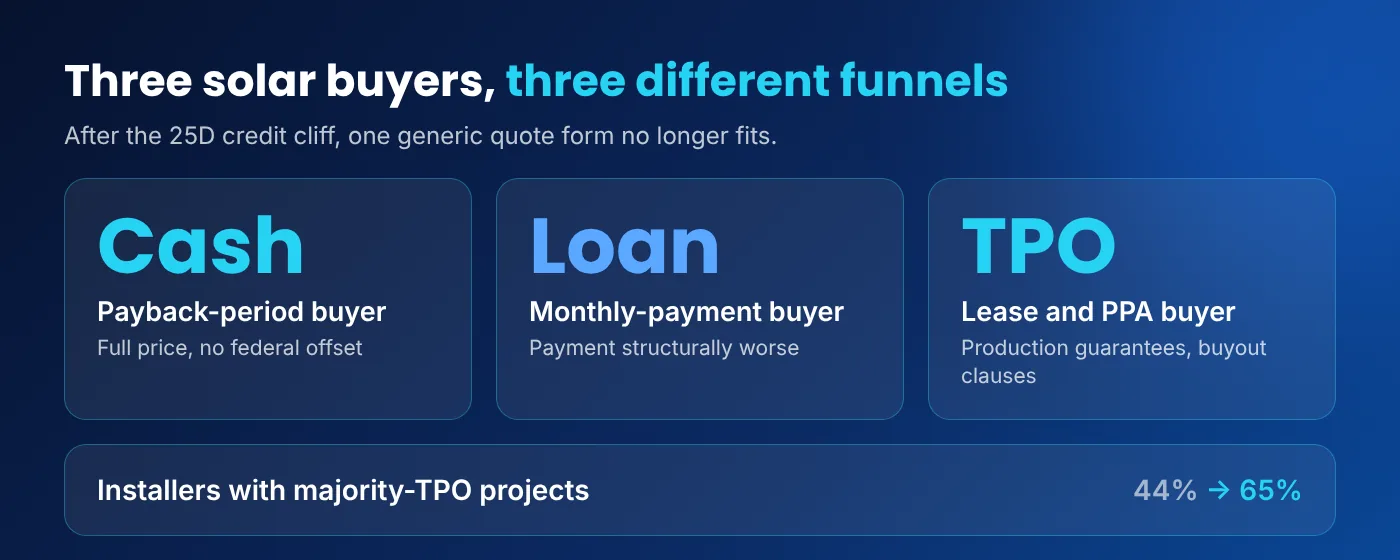
This inverts the financing logic that shaped solar marketing for years. A loan used to beat a lease because the homeowner captured the credit. Now the third-party owner captures it, and can pass some of that value through as a lower monthly rate, while a homeowner who wants to own their system outright pays the full price with no federal offset.
The marketing implication is direct: a website built around one generic "get your free solar quote" form is now serving three financially distinct customers.
- The cash buyer: doing a payback-period calculation.
- The loan buyer: whose monthly payment just got structurally worse.
- The TPO prospect: comparing lease terms, with entirely different questions about production guarantees and buyout clauses.
Sending all three into the same funnel, with the same message, is why "quality" complaints from sales teams are rising even as ad platforms report healthy conversion rates. The lead was never wrong for the campaign. The campaign was wrong for the lead.
Batteries Aren't an Upsell Anymore, They're the Product
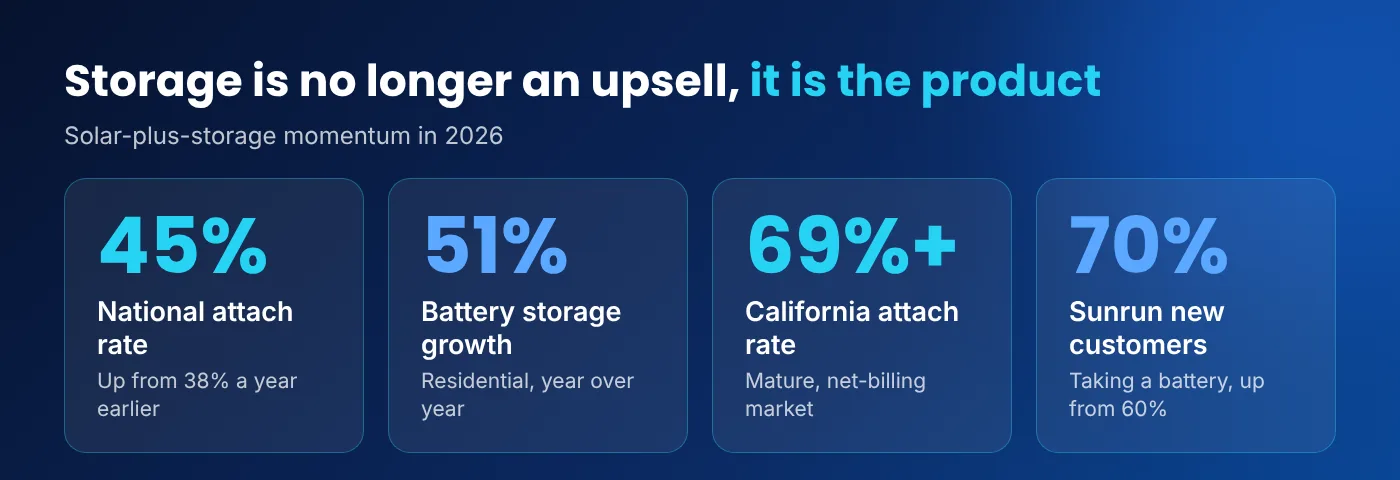
The second shift is what's actually growing inside a contracting market. National solar-plus-storage attach rates reached 45% in early 2026, up from 38% a year earlier, and residential battery storage grew 51% year-over-year. In mature markets like California, attach rates are above 69%. Sunrun, the largest residential installer, now reports 70% of new customers taking a battery, up from 60% two years ago, and has explicitly repositioned itself around a "storage-first" strategy rather than solar-only sales.
The reason is structural, not preference. Net billing policies in states like California now pay homeowners far less for power exported at midday than what they pay to import it at night, a gap wide enough that storing your own power is simply worth more than selling it back. That single policy shift did more to make batteries the default than any marketing campaign could.
The Virtual Power Plant Opportunity
There's a second driver most solar content hasn't caught up to: virtual power plant (VPP) programs, where utilities pay homeowners to let their battery discharge back to the grid during demand peaks. Enrollment in these programs is growing sharply; one major installer reported over 400% year-over-year growth in VPP participation, and homeowners in active markets can earn several hundred dollars a year in program payments on top of their energy savings.
None of this shows up in most solar marketing. Companies are still running "go solar and save on your bill" campaigns in a market where the more persuasive, more differentiated, and more true pitch is now about energy independence, backup power, and paid grid participation, a story that doesn't depend on a federal tax credit at all. A homeowner comparing installers in 2027 who sees one company still leading with panel savings and another leading with resilience and VPP income is going to trust the second one more, because it sounds like it understands the market they're actually buying into.
Prices Are Going Up, Not Down, and That Changes the Urgency Message
Solar marketing has spent a decade telling prospects that waiting usually pays off, because equipment costs keep falling. That assumption is no longer reliable.
- Panel frames and racking: a 50% tariff on imported aluminum is raising costs.
- Modules: new Section 232 tariff action on polysilicon is expected to push module prices higher through 2027, and most planned U.S. cell and wafer factories aren't expected to reach competitive scale before 2028.
- Forecasts: multiple industry analysts, including Intertek CEA and Roth Capital, now forecast rising, not falling, U.S. module prices for the next two years.
- Batteries: costs are moving in the opposite direction, falling an estimated 15-20% in 2026 as manufacturing scales.
So the honest, current picture is two-sided: panels are getting more expensive, storage is getting cheaper, and the credit that used to offset both is gone for direct owners.
That's a genuinely useful, differentiated message and a more credible one than the generic urgency copy ("act now, prices will only go up!") that solar marketing has overused for years without evidence. In 2027, the installers who can specifically and accurately explain why timing matters (module cost trajectory, TPO safe-harbor deadlines, state incentive sunset dates) will out-convert the ones still recycling stock urgency language that customers have learned to tune out.
The Bigger Threat Isn't Google Ranking, It's Not Being the Answer at All
The deepest shift, and the one solar marketing has barely started to address, is what's happening to search itself. Zero-click searches, where the user gets their answer without clicking any website, now account for roughly two-thirds of U.S. Google searches, up sharply from just two years ago. Google's AI Mode passed a billion monthly users within its first year of full rollout, and AI Overviews now reach an estimated 2.5 billion monthly users. Adobe's holiday-season retail data found that traffic referred from generative AI tools grew nearly 700% year-over-year, and converted 31% better than traffic from traditional search.
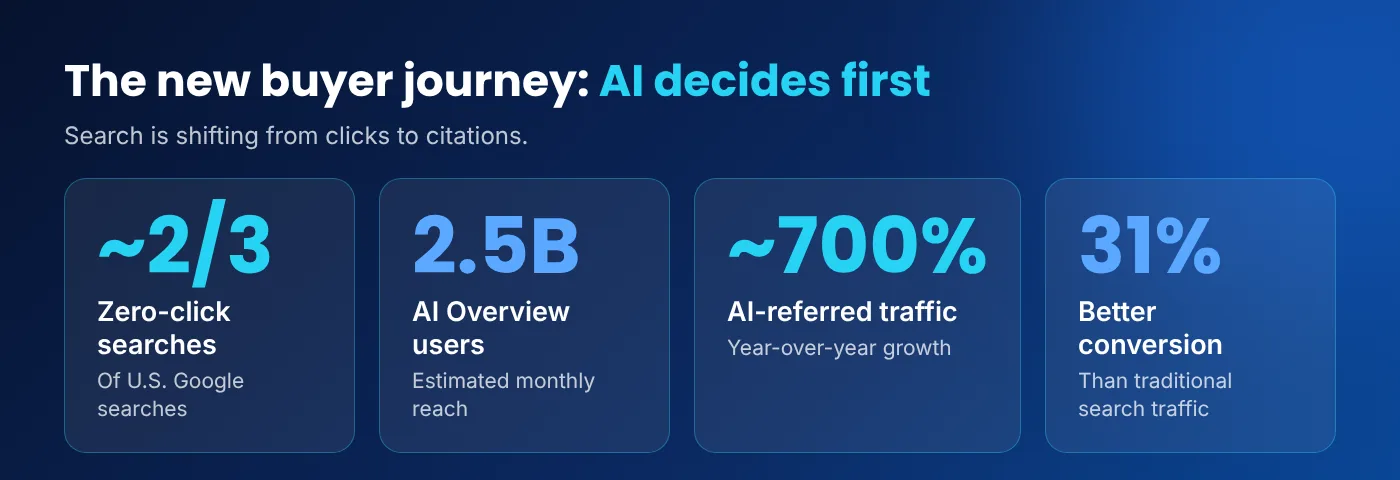
That last number matters more than the traffic growth itself: when an AI system recommends a business by name, the person clicking through is usually much further along in their decision than someone clicking a blue link. But that only helps a solar company if the AI system knows to recommend it in the first place.
This is a different discipline than traditional SEO, and most solar companies haven't started it. Being cited by ChatGPT, Gemini, Perplexity, or Google's AI Mode when someone asks "what should I know before choosing a solar installer" depends less on backlinks and keyword density, and more on whether a company's information is structured, consistent, and easy for a model to extract and trust: accurate schema markup, consistent business details across the web, clear first-party answers to the specific questions customers actually ask, and a reputation that corroborates across multiple sources rather than living only on the company's own site.
Practically, that means:
- Direct, extractable answers. A page explaining how solar financing changed after the tax credit expired should state the answer plainly in the first few sentences, not bury it under a narrative lead-in. That's the section a model is most likely to pull from.
- Structured data as infrastructure, not decoration. FAQ, HowTo, and local-business schema markup make the difference between a company being machine-readable and being invisible to the systems that now sit in front of a third of all searches.
- Consistency over volume. An AI system weighs whether a company's name, service area, and claims are corroborated the same way across its own site, review platforms, and directories, more than how many pages it has published.
Companies that treat this as "SEO but with extra steps" will miss the point. The audience for this content increasingly isn't a person scanning a results page. It's a model deciding whether to say a company's name out loud.
What This Actually Means for 2027 Strategy
None of this points to more spend on the old channels. It points to a more segmented, more accurate approach.

- Financing-specific paths. Separate content and landing experiences for cash, loan, and TPO prospects, since they're now financially different customers with different objections, not one generic quote form serving all three.
- Storage as the lead story, not the add-on. Resilience, backup power, and VPP income are more differentiated and more durable selling points than panel savings alone, especially with attach rates already above two-thirds in mature markets.
- Accurate, specific urgency. Real cost trajectories, tariffs pushing panel prices up, storage prices down, and safe-harbor deadlines for TPO, instead of generic scarcity language customers have already learned to discount.
- Machine-readable authority. Structured data, consistent business information, and directly answerable content built for citation by AI systems, not just ranking by traditional search.
The installers who win the next two years won't be the ones spending the most to reach a shrinking pool of buyers. They'll be the ones who rebuilt their marketing around what the market actually is now: a TPO-dominant, storage-first, price-rising, AI-mediated buying process, rather than the one that existed when the tax credit was still doing most of the persuading.
Building a More Connected Digital Foundation for Solar Growth
For solar companies, improving customer acquisition increasingly requires more than a collection of campaigns. It requires digital systems that connect the website, marketing channels, customer data, lead management, sales workflows, and performance measurement.
Sigma Solve works with businesses to build and improve those digital foundations through digital transformation, web development, CRM and workflow integration, automation, data solutions, AI-enabled processes, and customer-facing digital experiences. The objective is not simply to add more technology. It is to reduce the gaps between customer interest, internal processes, and measurable business outcomes.
If your solar business is looking to reduce friction across the customer journey and build a more connected, measurable approach to customer acquisition, Sigma Solve can help you identify where your current digital ecosystem is holding back and what it will take to improve it.