
AI in Healthcare: From Generative AI to Intelligent, Connected Care
Shivam B. · 8/26/2026 · 7 min read

Artificial intelligence is no longer a future concept in healthcare. Organizations are already using it to summarize clinical information, support documentation, automate administrative processes, engage patients, analyse data, and assist decision-making, and the technology continues to evolve quickly.
The first wave of healthcare AI focused on prediction and pattern recognition. Generative AI enabled the creation, summarization, and retrieval of information, and copilots brought that capability directly into the daily work of clinicians and administrators. Now the industry is moving toward something more consequential: AI systems that understand context, retrieve trusted information, and participate in workflows.
That shift changes the question healthcare leaders need to ask. It is no longer simply about what AI can do. The more useful question is what does it take to make AI work reliably across a complex healthcare environment? The answer goes well beyond choosing a model. Healthcare AI depends on connected data, interoperability, trusted knowledge, workflow orchestration, governance, and human oversight; without those foundations, even the most advanced AI can remain an isolated experiment.
The New Healthcare AI Landscape: From Prediction to Action
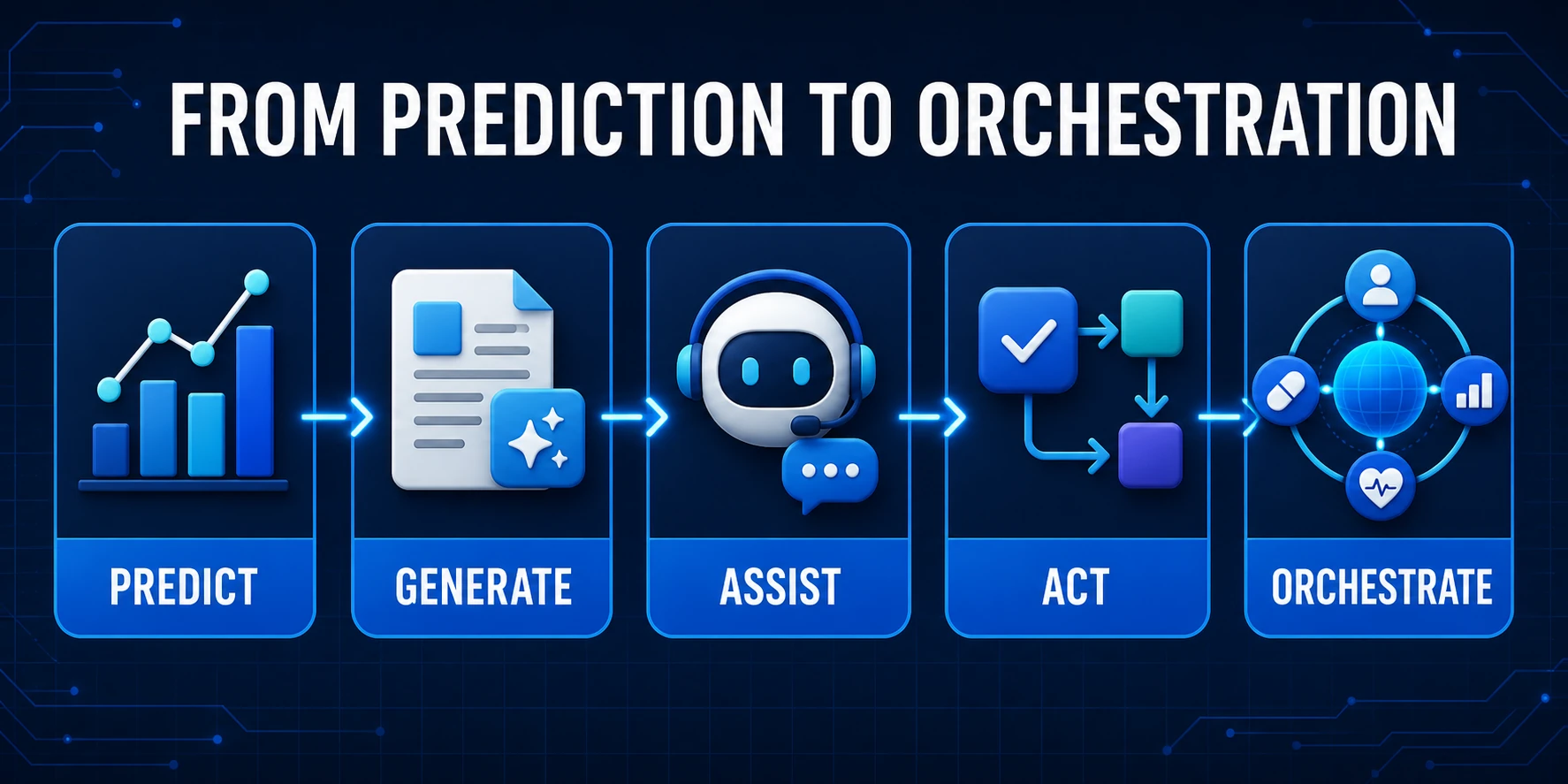
Healthcare AI is evolving through several stages, each building on the previous one.
Predict: Traditional AI and machine learning analyse historical and real-time data to identify patterns, classify information, and predict outcomes; risk prediction, medical image analysis, fraud detection, population health analytics, and demand forecasting are all examples in production use today.
Generate: Generative AI introduced the ability to create new content and transform unstructured information into useful output, including summarizing patient records, drafting clinical documentation, generating discharge instructions, simplifying medical information, and supporting knowledge retrieval.
Assist: AI copilots bring these capabilities into the daily workflow of clinicians, administrators, and other healthcare professionals. Rather than replacing users, copilots help them search, summarize, document, and navigate information faster than they could on their own.
Act: AI agents go a step further by responding to more than prompts. Within defined permissions, they can retrieve information, follow workflow logic, trigger actions, and route exceptions. An AI agent supporting a patient access workflow, for example, could retrieve relevant information, verify eligibility, identify missing documentation, and route complex cases to a human reviewer.
Orchestrate: The next stage is unlikely to involve one powerful AI system doing everything. It is more likely to involve multiple specialized systems and agents working across a connected healthcare environment, one handling patient access, another supporting documentation, another preparing prior authorization information, with an orchestration layer coordinating how those systems exchange information and determining when human intervention is required. This progression, from prediction to orchestration, is reshaping how healthcare organizations think about AI.
What Is Generative, Multimodal and Agentic AI in Healthcare?
These terms are often used interchangeably, but they describe distinct capabilities.
Generative AI creates or transforms information. A healthcare professional might use it to summarize a patient history, draft a clinical note, generate patient-friendly explanations, or search and synthesize medical knowledge. Its primary role is intelligence expressed through language and content generation.
Multimodal AI addresses the fact that healthcare information doesn't exist in text alone; it spans clinical notes, medical images, lab results, vital signs, genomic data, voice, video, and wearable or remote monitoring data.
AI copilots assist people while they work. Humans remain responsible for reviewing information and making decisions, while AI reduces the effort required to find, organize, and process that information.
Agentic AI introduces a greater degree of workflow participation. An AI agent can receive a request or trigger, retrieve relevant information, evaluate that context against defined rules, take an approved action, update a connected system, and escalate exceptions. The distinction matters: a generative AI system might summarize a patient's record, while an AI agent could use that summary as one step within a larger workflow.
Where Is AI Creating Real Value Today?
Healthcare AI has applications across the industry, but the most valuable opportunities tend to concentrate in a few areas.
Clinical intelligence: AI can help clinicians manage the growing volume of information tied to patient care through ambient documentation, patient chart summarization, clinical information retrieval, care plan support, medical coding assistance, and clinical communication. The objective isn't to generate more information; it's to reduce the time required to find, interpret, and document the information that already exists.
Administrative operations: Administrative processes remain one of the most immediate opportunities for AI. Healthcare organizations manage large volumes of repetitive, information-intensive work across eligibility verification, prior authorization, scheduling, intake, document processing, reconciliation, and claims workflows. These processes are particularly well suited to intelligent automation because they typically involve structured rules, repeated actions, and predictable handoffs.
Patient access and engagement: AI can support patients before and after clinical interactions through appointment scheduling, patient communication, care navigation, follow-up reminders, routine information requests, and escalation to the appropriate team. The goal isn't to replace human interaction everywhere; it's to make routine access and communication easier while ensuring complex or sensitive situations still reach the right person.
Revenue and care coordination: AI can also help organizations identify missing information, prepare documentation, support coding, and improve coordination across teams and systems. Some of healthcare AI's strongest business value comes from operational problems rather than highly visible clinical applications; a solution doesn't need to diagnose a disease to create meaningful impact. Reducing delays, errors, manual work, and revenue leakage delivers value that's just as measurable.
The Next Frontier: Multimodal AI, Digital Twins and Predictive Care
The current generation of healthcare AI is already changing how information is processed and workflows are executed. The next frontier will involve a richer understanding of health data itself.
Future systems will increasingly combine text, images, signals, and other forms of patient information through multimodal AI. Digital twins could enable organizations to model and simulate aspects of patients, operations, or clinical environments using connected data and predictive technologies. And as healthcare organizations connect more data, predictive and preventive care may help identify risk earlier and support interventions before conditions become more serious.
These technologies remain dependent on the same fundamentals as everything before them: a healthcare organization cannot fully benefit from advanced AI if its underlying information stays fragmented, inaccessible, or unreliable.
The Healthcare AI Stack: What Needs to Work Behind the Model?
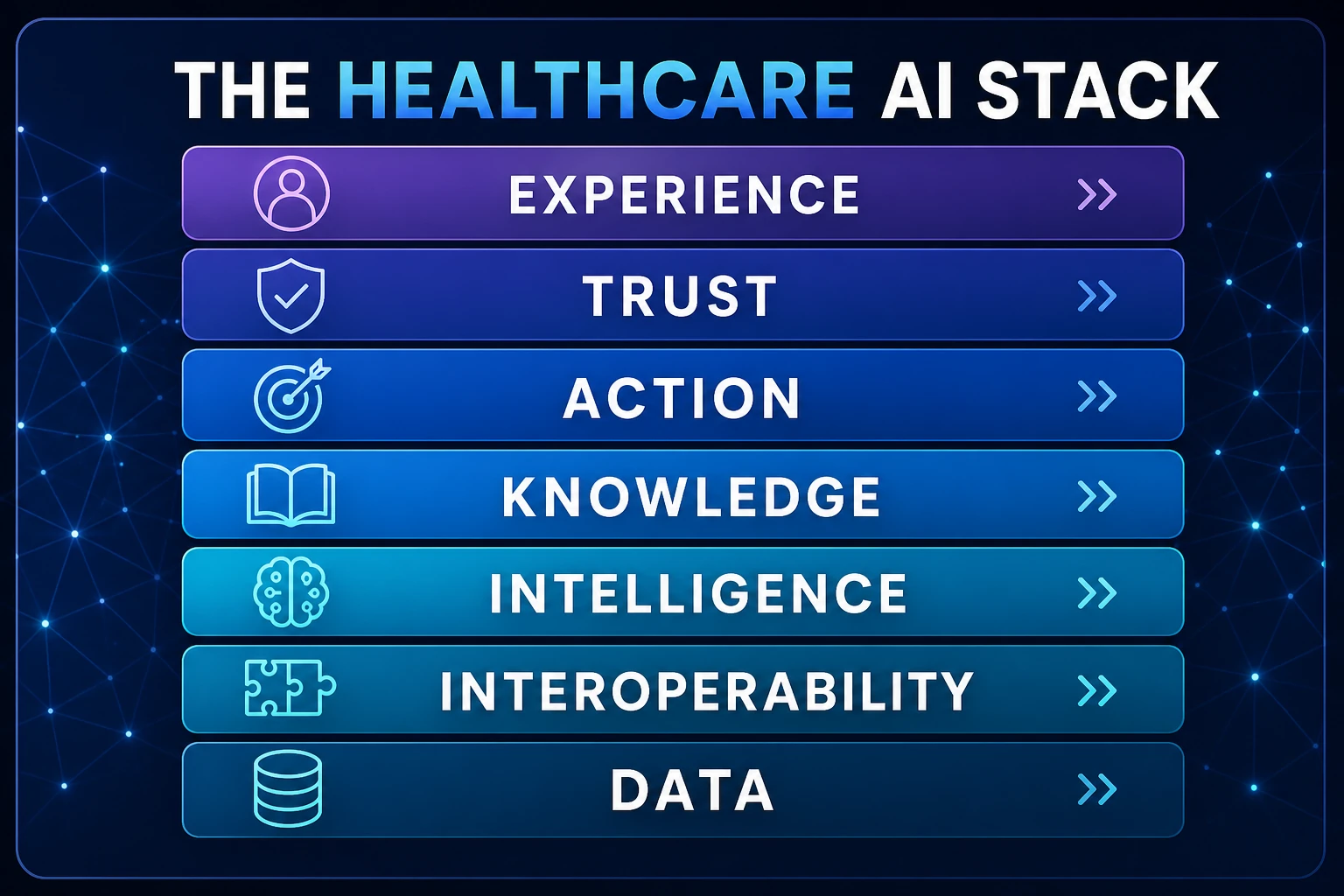
An AI model is only one component of an enterprise healthcare solution. For AI to operate reliably, several layers need to work together.
Data: Healthcare AI may need information from EHR systems, RCM platforms, payer systems, laboratory systems, imaging systems, internal applications, and patient-generated data. The challenge is rarely the absence of data; more often, it's fragmentation.
Interoperability: AI cannot create much value if critical information remains trapped inside disconnected systems, which makes interoperability a foundational requirement. Standards and technologies such as FHIR, HL7, APIs, integration platforms, and data pipelines create the pathways through which information moves between systems.
Intelligence: This is where different AI technologies operate: machine learning, generative AI, multimodal models, predictive analytics, and AI agents. The right technology depends on the problem: not every workflow requires an LLM, and not every process requires an autonomous agent.
Knowledge: Enterprise AI needs access to trusted information, including clinical protocols, internal policies, care pathways, approved documentation, and organizational knowledge. This is where retrieval-augmented generation, or RAG, becomes relevant.
Action: AI becomes operationally useful when it can connect intelligence to action, whether through copilots, workflow automation, AI agents, orchestration, or human approvals.
Trust: Healthcare AI requires a layer of control around the technology, including access management, security, governance, monitoring, auditability, evaluation, and human oversight.
Experience: Finally, AI needs to work for the people using it, clinicians, administrators, care coordinators, and patients. The most sophisticated architecture has limited value if it just becomes another disconnected tool that people don't want to use.
Why Healthcare AI Needs a Trusted Knowledge Layer
One of the biggest risks with general-purpose generative AI is that it can produce information that sounds convincing but is inaccurate, incomplete, or unsupported. Healthcare organizations cannot rely solely on a model's general knowledge; AI systems increasingly need to be grounded in trusted, relevant information, retrieved from approved sources before a response is generated. An internal healthcare AI assistant, for instance, may need to reference approved clinical guidance, organizational policies, care protocols, current documentation, and role-specific knowledge.
A trusted knowledge layer also requires control over who can access information, which sources are approved, how current the information is, and what should not be exposed. The goal isn't simply to make an AI system more knowledgeable; it's to make its responses more relevant, traceable, and appropriate for the context in which they're used.
Build, Buy or Integrate? The Healthcare AI Decision
Healthcare organizations don't have a single path to AI adoption. In most cases, the first decision is whether to buy, build, or integrate.
Buy when the workflow is relatively standardized, a mature healthcare-specific product already exists, speed of deployment is a priority, and customization requirements are limited; specialized documentation, coding, or patient engagement solutions are common examples.
Build when the workflow is unique, existing products don't fit the organization's environment, the AI capability itself is strategically differentiated, or deep customization is required. Building, however, brings its own responsibilities around architecture, integration, security, testing, and ongoing maintenance.
Integrate is often the most overlooked part of the decision. An organization may already have an AI model or application; the real challenge is connecting it to the systems, data, and workflows where the work happens, which can involve EHR integration, RCM integration, payer connectivity, API development, data engineering, workflow automation, and governance controls.
For most organizations, the answer won't be purely build or buy; it will be some combination of buying specialized software, using an enterprise AI platform, and building the custom workflows that connect those capabilities to the existing technology environment.
Is Your Organization Ready for Healthcare AI?
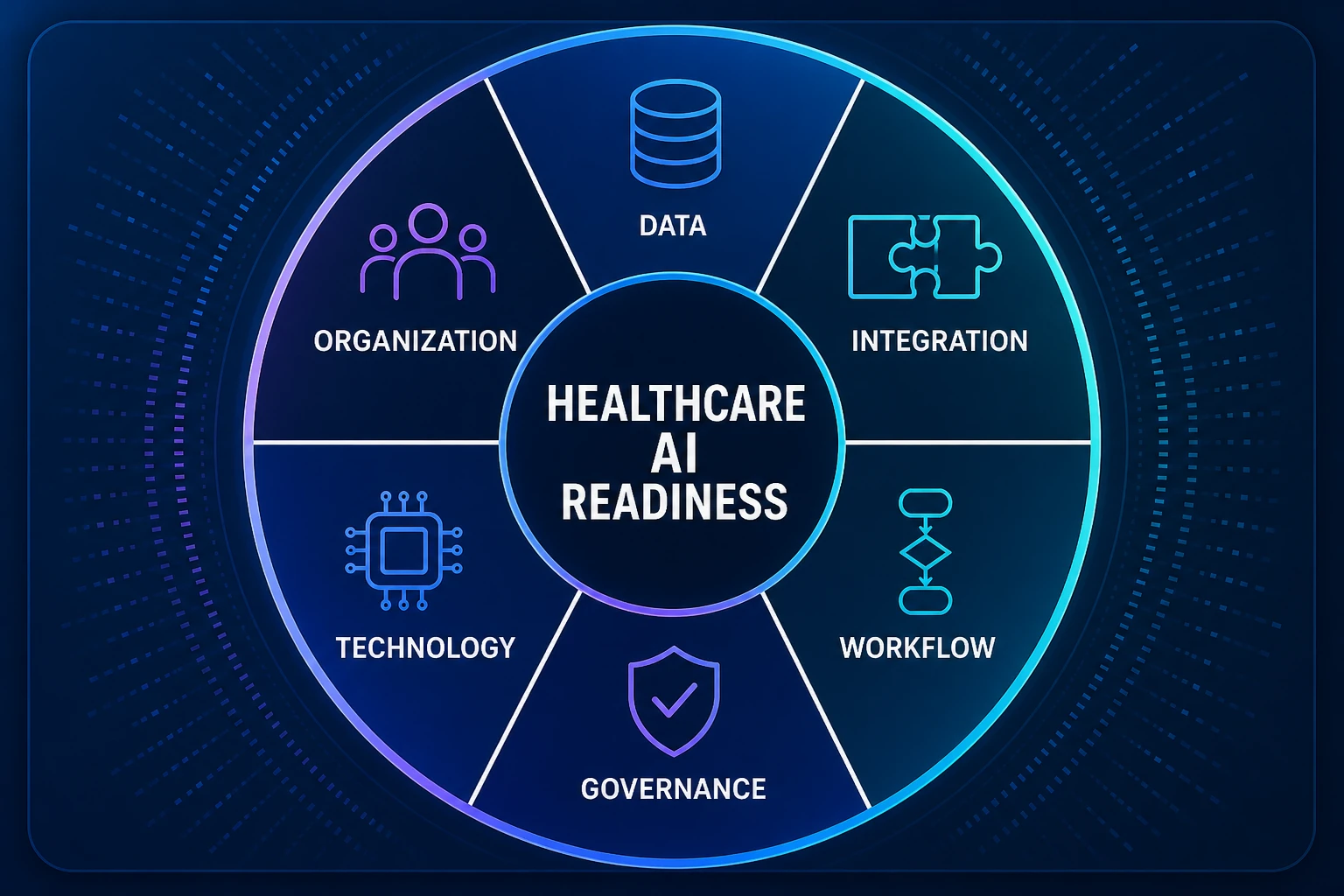
Before selecting a use case, healthcare leaders should evaluate readiness across several dimensions.
Data Readiness: Is the required information accessible, accurate, complete, and governed?
Integration Readiness: Can the relevant systems securely exchange information, with the necessary APIs, interoperability standards, and integration capabilities in place?
Workflow readiness: Is the existing process well understood? Automating a poorly defined workflow tends to just make existing problems move faster.
Governance readiness: Are responsibilities clearly defined, who approves AI use cases, when human review is required, how performance will be monitored, and what happens when an error occurs?
Technology readiness: Can the organization support secure data access, scalable infrastructure, AI integration, monitoring, and identity and access management?
Organizational readiness: Technology adoption also depends on people. Healthcare professionals need to understand what the AI does, what its limitations are, and when to rely on their own judgment instead.
AI readiness is therefore not a single technical assessment; it's an assessment of the entire environment in which the AI will operate.
The Missing Layer in Most Healthcare AI Conversations: Integration
Healthcare organizations do not operate on a single technology platform.
Patient information may live in an EHR. Financial and billing processes may rely on separate revenue cycle systems. Eligibility and authorization workflows may involve payer platforms, while laboratory, imaging, and operational information may sit in additional applications. AI does not remove this complexity. In many cases, it exposes it.
For example, Sigma Solve helped a U.S.-based healthcare distributor automate and modernize its order processing operations. The organization was handling approximately 7,000 orders each month through a heavily manual process that required five full-time representatives. By introducing RPA, integrating key operational systems, and restructuring supporting workflows, the company achieved a 67% reduction in manual order processing time, 91% automation accuracy, and $184,000 in annual cost savings.
The result demonstrates an important point: meaningful healthcare transformation does not always begin with a clinical AI use case. Automating high-volume, repetitive processes can reduce errors, improve efficiency, and create the operational capacity needed to scale.
Read the full case study: RPA-Driven Automation Transforms Order Processing for a Healthcare Distributor
An AI assistant can only provide a complete answer if it has access to the relevant information. An AI agent can only participate in a workflow if it can interact safely with the systems involved. If data remains inaccessible or disconnected, even an advanced model can become another isolated application. This is why integration deserves greater attention in the healthcare AI conversation.
For many organizations, the path forward will involve combining existing healthcare applications, enterprise AI platforms, and custom-built capabilities. The competitive advantage will come from how effectively those components are connected. And this is where partners like Sigma Solve can help.
The Future of Healthcare AI Is Connected Intelligence
The future of healthcare AI isn't a single model replacing doctors or an autonomous agent running an entire hospital. It's more likely to be an ecosystem of connected capabilities, with generative AI helping people process information, copilots assisting them in everyday work, ambient AI reducing the effort to capture and organize context, AI agents participating in defined workflows, and predictive and multimodal systems creating new opportunities for personalized and proactive care.
Intelligence alone won't be enough, though. For AI to create lasting value, the architecture around the model needs to work: connected data, interoperable systems, trusted knowledge, well-designed workflows, secure integrations, governance, and human oversight. This is where healthcare AI moves beyond experimentation. The organizations that succeed won't necessarily be the ones using the most AI tools; they'll be the ones that know where AI fits, connect it to the right information, and integrate it into the workflows where meaningful work already happens.
Build an AI-Ready Healthcare Foundation
AI can create meaningful value across healthcare, but successful implementation starts with more than selecting a model or launching a pilot. Healthcare organizations need connected data, interoperable systems, and workflows designed to support intelligent automation.
Sigma Solve helps healthcare organizations modernize fragmented technology environments, connect data across EHR, RCM, payer, and lab systems, build interoperable architectures, and develop AI-powered workflows that fit real operational needs. The goal is not simply to add AI to healthcare; it's to build the connected foundation that allows AI to work.
Explore how Sigma Solve can help you build a connected, AI-ready healthcare ecosystem.