
AI in DevOps in 2026: From Automation to Agentic Software Delivery
Milind Shah · 5/31/2023 · 9 min read

Artificial intelligence is changing how software is built, tested, deployed and operated. Earlier discussions of AI in DevOps focused on automation, predictive analytics and AIOps. In 2026, generative AI is embedded in development workflows, and AI agents can handle multi-step engineering tasks with limited human intervention.
AI is no longer just another automation layer in the pipeline. It is becoming part of the software delivery system itself: interpreting context, generating solutions, investigating failures and working with development and infrastructure tools.
More AI does not automatically mean better delivery. DORA's research found AI can raise developer productivity while exposing weaknesses in an organization's engineering systems. The teams that gain most have strong engineering practices, reliable platforms, effective observability and clear governance.
The opportunity in 2026 is not simply to automate DevOps. It is to build a more intelligent, reliable, secure and adaptive software delivery environment, a core part of any digital transformation effort.
What Is AI in DevOps?
AI in DevOps applies artificial intelligence, machine learning, generative AI and AI agents across the software development and operations lifecycle.
Traditional DevOps connected development and operations through CI/CD, infrastructure as code, monitoring and feedback loops. AI adds an intelligence layer that analyzes code, deployment data, telemetry, security findings and past incidents to support decisions.
- Generative AI helps engineers write and understand code, create tests, troubleshoot problems, generate documentation and work with infrastructure configurations.
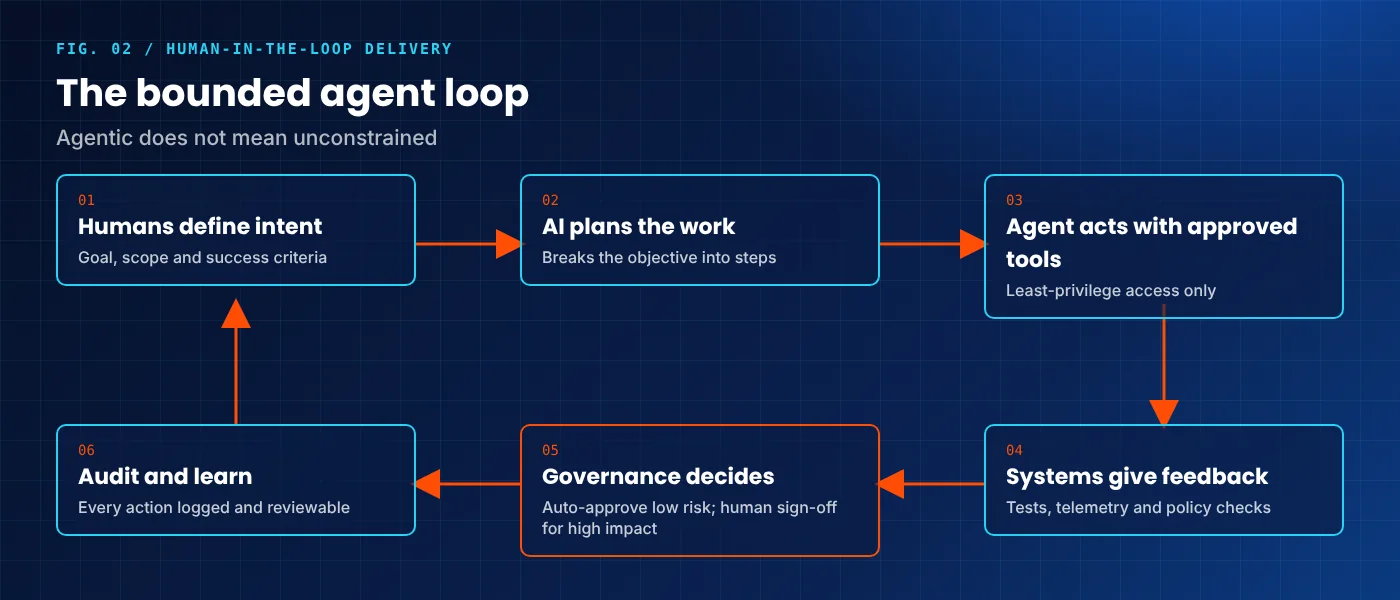
- AI agents go further. An agent interprets an objective, plans a sequence of actions, uses approved tools, evaluates results and keeps working toward the outcome.
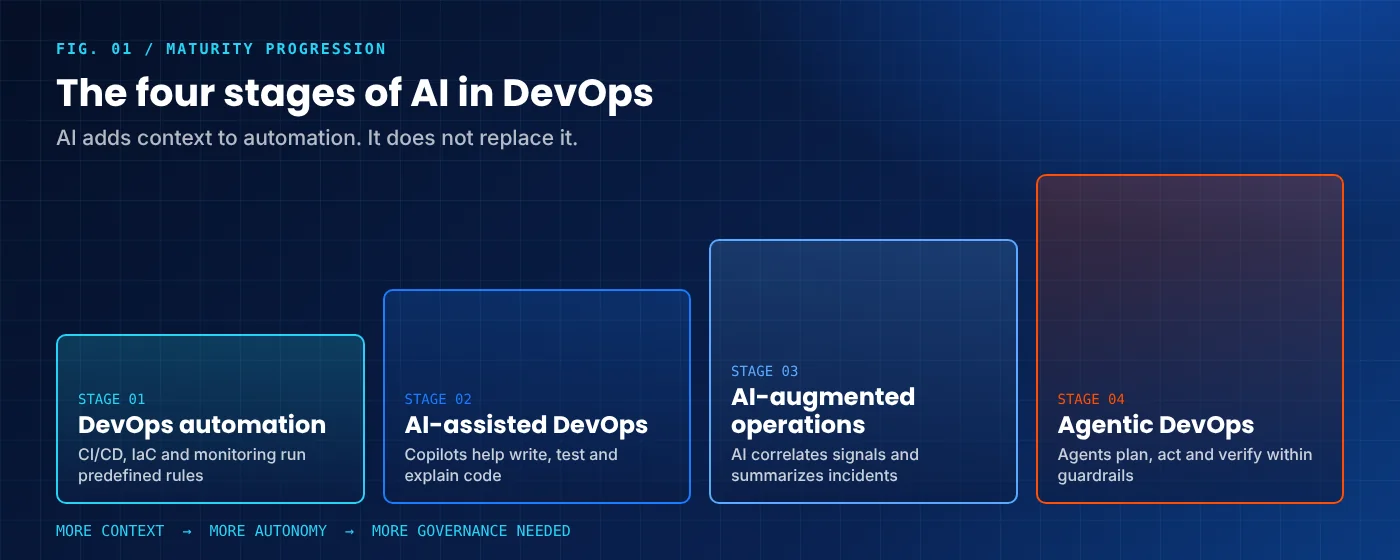
AI does not replace automation. It makes parts of delivery more contextual and adaptive, while deterministic automation keeps execution predictable and controlled.
How AI Is Transforming DevOps in 2026
The most visible change is in software development. AI coding assistants help developers understand unfamiliar codebases, write tests, refactor code, explain errors and prepare documentation, cutting time spent on repetitive work.
But faster code creation creates a new challenge: verification. AI-generated code still has to be reviewed, tested, secured and checked against business requirements. DORA's research shows AI can lift individual productivity while putting pressure on delivery stability.
Measure whether AI improves the whole delivery system, not whether more code gets generated. Continuous integration, automated testing, small change sizes, code review and observability provide the feedback needed to validate AI-assisted development at scale.
From AI Assistance to Agentic DevOps
The biggest shift in 2026 is from AI assistance to agentic software delivery.
An assistant might explain why a deployment failed. An agent can investigate by examining logs, deployment history, configuration changes and service dependencies, identify a probable cause, recommend a fix and start an approved remediation workflow. Engineers define objectives while AI handles parts of the investigation or execution.
Microsoft is building agentic capabilities across software development and DevOps workflows, and Google has explored agentic AI for SRE tasks such as incident investigation and communication.
"Agentic" does not mean unconstrained. In enterprise environments, agents work within defined permissions and policies. Low-risk, reversible actions can be automated, while changes to critical production systems stay subject to human approval.
AI-Powered CI/CD and Testing
Traditional pipelines execute predefined rules. AI adds contextual analysis. It can help engineers:
- Understand failed builds
- Prioritize relevant tests
- Spot suspicious changes
- Tell whether a failure comes from application code, infrastructure, dependencies or the deployment environment
Testing matters most here, because AI increases the volume of code that can be produced. AI can generate test cases and surface edge cases, but generated tests are only useful when they reflect real acceptance criteria and business behavior. A technically valid test can still miss what matters to the business.
AI expands testing capacity. Engineers remain responsible for defining quality and judging critical scenarios.
Intelligent Observability and AI-Assisted SRE
Distributed applications produce huge volumes of logs, metrics, traces, deployment events and security alerts. During an incident, AI can turn that volume into operational intelligence by correlating events, flagging anomalies, summarizing incidents, suggesting probable root causes and surfacing similar past incidents.
Operations is evolving along this path:
Monitoring → observability → AIOps → AI-assisted SRE → agentic operations
The final stage adds a new requirement: the AI itself must be observable. When an agent works on an incident, teams need to see what information it accessed, which tools it used, what actions it attempted and why. Agent observability is becoming a core part of modern operations architecture.
AI and DevSecOps: A Bigger Opportunity With Bigger Risks
AI can find vulnerabilities, analyze dependencies, review code, prioritize security findings and assist remediation, helping teams fix issues earlier in the lifecycle. Careless implementation, however, creates serious risk.
- Hidden vulnerabilities: AI-generated code can introduce flaws developers do not immediately recognize.
- Excessive access: Agents may need access to repositories, cloud environments, deployment systems and databases. Over-broad permissions turn a compromised or misdirected agent into an operational risk.
Organizations should give agents clear identities and permissions, protect sensitive data, keep audit trails, validate AI-generated changes and require human approval for high-impact actions. OWASP's emerging guidance on agentic applications reflects this challenge, and the NIST AI Risk Management Framework is a useful foundation.
The more authority an AI system has, the stronger its controls need to be.
Platform Engineering Becomes More Important
Internal developer platforms give teams standard ways to build, deploy, observe and operate applications. As AI agents join software delivery, platforms will need to serve both humans and machines.
An agent may need to create an environment, run tests, retrieve observability data, open a pull request, request infrastructure or start a deployment. For that to be safe and repeatable, the platform needs consistent interfaces, identity management, permissions, policies and auditability. A solid cloud and infrastructure foundation is what makes this possible.
CNCF research points to continued growth in cloud-native development and rising importance of platform engineering for modern application and AI workloads. Platform engineering is more than a developer-experience initiative. It can be the control layer that standardizes and governs AI-enabled delivery.
The Business Value of AI in DevOps
The business case is not just that engineers write code faster. Speed matters, but it is one part of delivery performance. AI reduces friction by helping teams understand systems, troubleshoot failures, create tests and process operational data.
The larger payoff comes when gains compound across the lifecycle:
- Faster development is worth more when testing keeps pace.
- Faster deployments are worth more when observability catches problems quickly.
- Automated remediation is worth more when infrastructure and security policies set clear boundaries.
Evaluate AI on measurable outcomes rather than AI usage or lines of code generated:
| Outcome | What to measure |
|---|---|
| Delivery speed | Lead time and deployment frequency |
| Quality | Change failure rate |
| Resilience | Recovery time and operational reliability |
| People | Developer experience and engineering effort |
| Cost | Infrastructure and AI workflow cost |
Challenges Organizations Need to Address
AI adoption brings challenges that technology alone cannot solve.
- Technical debt: When code is easy to generate, complexity can grow faster than teams can review and maintain it. Strong architecture standards and engineering ownership are essential.
- Context: AI depends on the information available to it. Fragmented documentation, poor observability, inconsistent infrastructure and inaccessible knowledge limit its value.
- Autonomy: Unrestricted agent access to production can create more risk than value. Decide which tasks are safe to automate and set approval and rollback mechanisms.
- Cost: Model usage, infrastructure, agent execution and higher software throughput all affect budgets. FinOps must evolve alongside AI adoption, weighing the cost of AI-enabled workflows against the outcomes they deliver.
How to Build an AI-Enabled DevOps Strategy
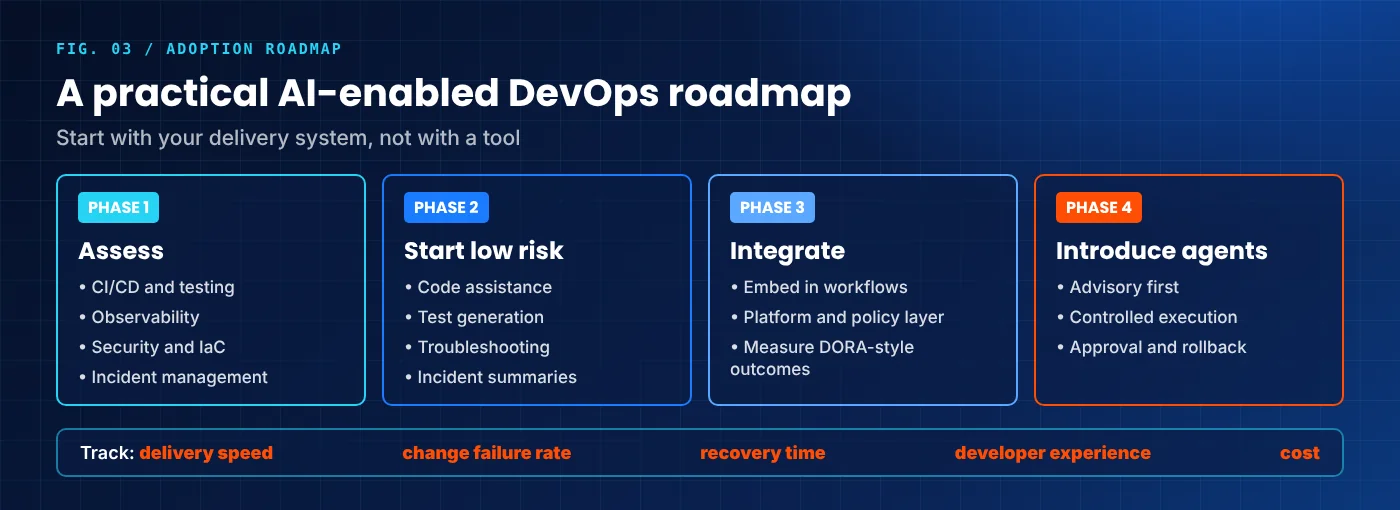
Start with your existing delivery environment, not with an AI tool.
- Assess maturity. Evaluate CI/CD, testing, observability, security, infrastructure automation, developer experience and incident management. This shows where AI can create value and where foundations need work first.
- Pick measurable, low-risk use cases. Development assistance, documentation, test generation, troubleshooting and incident summarization are good starting points because impact is easy to evaluate without giving AI control of critical systems.
- Integrate into existing workflows. Embed AI in how engineers already work rather than running it as a separate experiment.
- Introduce agents gradually. Begin with advisory tasks, then move toward controlled execution as benefits and risks become clear.
Moving from experiments to production takes more than tooling. Sigma Solve's AI Center of Excellence and AI development services help teams put governance, measurement and delivery practices in place.
What Does the Future of AI in DevOps Look Like?
The future of DevOps is a closer partnership between engineers, AI systems and intelligent platforms.
- Developers will work alongside coding agents.
- CI/CD pipelines will carry more contextual intelligence.
- Observability platforms will assist with investigation and diagnosis.
- Internal developer platforms will provide governed environments for people and AI agents.
- Security controls will account for machine identities and autonomous actions.
This does not make engineers less important. It changes where their expertise counts: architecture, system design, security, reliability, governance and business decisions. Leaders will need to decide not only what AI can do, but what it should be allowed to do.
The winners will not be the organizations that automate the most tasks. They will be the ones that combine AI capability, engineering discipline, platform maturity, observability, security and human oversight.
Conclusion
AI is turning DevOps from an automation-driven discipline into an intelligent, adaptive software delivery model. Generative AI is already changing development and testing, AI-powered observability is improving how teams understand complex systems, and agents are making delivery and operations more goal-oriented.
Successful adoption takes more than adding smart tools to a pipeline. It needs reliable engineering practices, strong platforms, comprehensive observability, secure access controls and governance that decides where autonomy is appropriate.
The future is not about removing humans from DevOps. It is about giving engineers better systems to build, operate and improve software. For enterprises, the 2026 opportunity is to move beyond experimentation and build a governed, measurable, AI-enabled DevOps environment that improves delivery without compromising quality, security or reliability.
Ready to Build AI-Enabled DevOps?
Sigma Solve helps organizations evaluate DevOps maturity, identify high-value AI opportunities, modernize CI/CD and observability, and build AI-enabled engineering workflows aligned with business goals.
