
React vs Angular in 2026: Choosing the Right Framework
Milind Shah · 11/6/2024 · 18 min read

Choosing a front-end framework is rarely just a technology decision. It affects how quickly a team builds, how consistently different developers work, how easily the application evolves, and how much effort it takes to maintain over time.
For years, the comparison followed a predictable script: React was lightweight and flexible, good for dynamic interfaces; Angular was the comprehensive, opinionated choice for large enterprise systems. That distinction was always an oversimplification, and it's even less useful now.
Both frameworks have moved past their old reputations. Modern React extends well beyond client-side single-page apps; React Server Components are now the production-standard architecture, not an experimental add-on. Angular has shipped stable zoneless change detection and Signal Forms, closing the gap on reactivity and bundle size that used to be React's clearest advantage.
So, the decision isn't "fast framework vs. heavy framework" anymore. Both can support complex, high-performance, business-critical applications. The real question is how you want to manage complexity as the application and the team behind it grow.
The Comparison Has Changed
Older React vs. Angular comparisons focused on implementation details: Virtual DOM vs. Real DOM, JSX vs. templates, and one-way vs. two-way data binding. Those differences still exist, but they don't tell a decision-maker much about which technology fits a real product. A CTO evaluating a new customer platform isn't deciding based on DOM strategy; they're weighing multi-year maintainability, onboarding speed for new developers, and how much architectural freedom different teams need.
The ecosystems reflect this shift. React 19 introduced stable support for Server Components in frameworks that implement the full-stack React architecture, and Next.js 15 now ships RSC as the default. Angular 22, released in June 2026, has moved zoneless change detection from experimental to default-for-new-projects, alongside stable Signal Forms and selectorless components, the culmination of the signals-first direction Angular set with version 17.
Neither framework should be evaluated on its old reputation. React is no longer just "the flexible library." Angular is no longer adequately described as "heavy with a steep learning curve."
The Real Difference: Who Makes the Architecture Decisions
React gives developers a strong foundation for building interfaces but leaves routing, state management, data fetching, and rendering patterns for the team to assemble. That flexibility is a strength; it lets teams avoid forcing every application into the same mold, but it also means a React application reflects whatever decisions the team made. Two organizations using React can end up with entirely different structures. When those decisions are deliberate and backed by strong engineering standards, React scales well. When they're not, flexibility drifts into inconsistency.
Angular takes the opposite approach: instead of asking every team to make foundational architecture calls, it provides established conventions from the start. Developers still make choices, but the boundaries are more clearly defined. That matters most when multiple teams are contributing to the same product, and consistency is as important as individual freedom.
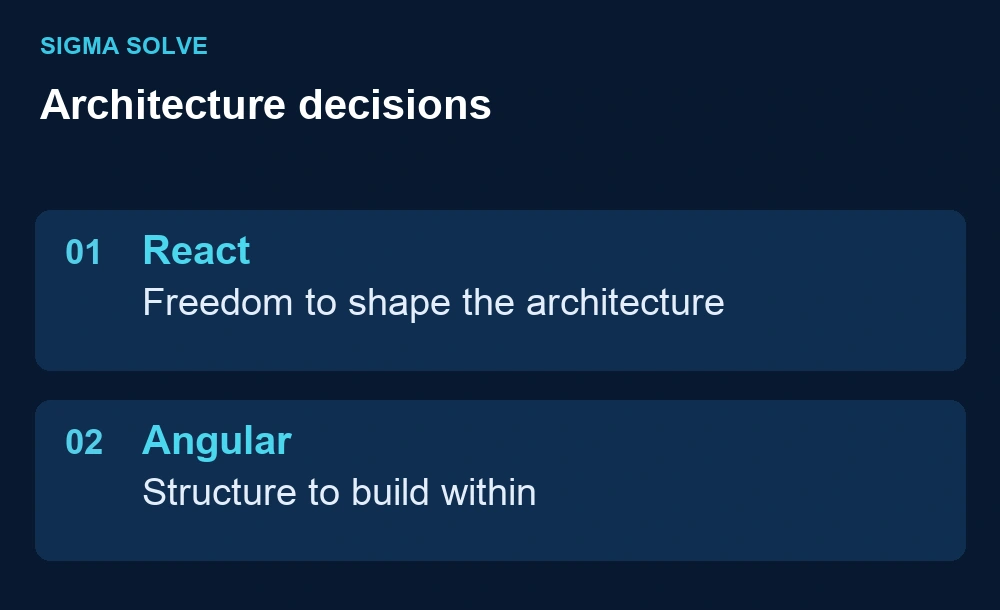
This is the distinction that drives long-term development outcomes, more than any feature-by-feature comparison. React gives teams freedom to shape the architecture. Angular gives teams structure to build within. Neither is inherently better; it depends on the product and how the organization works.
What this means in practice, at scale: picture a product growing from one team to ten. With React, the organization must build its own consistency, internal conventions for state management, data fetching, testing, and that consistency won't happen automatically without clear guidelines. Angular reduces that variation by providing more of the standard upfront, at the cost of a steeper initial learning curve. A well-architected React app can be extremely maintainable; a poorly structured Angular app can become unnecessarily complex. The framework doesn't determine software quality; it determines where the responsibility for consistency sits.
Performance, Scalability, and Maintenance Are the Same Question
Older comparisons treat performance, scalability, and maintainability as separate concerns. They're not. An application isn't scalable just because the framework supports large applications; it needs an architecture that can evolve without becoming unreadable. And performance isn't determined by Virtual DOM vs. change-detection strategy; it's determined by how much code reaches the browser, how content renders, and how efficiently the app avoids unnecessary work.
Both ecosystems now address this directly. React's RSC architecture reduces client-side JavaScript by rendering more of the tree on the server. Angular's zoneless mode removes Zone.js entirely, roughly 33KB off the bundle, and lets signals drive precise, dependency-graph-based updates instead of global change detection sweeps.
The more meaningful difference, for most organizations, is whether the team can maintain the architecture behind those capabilities five years from now.
Choosing Between Them: Four Questions That Actually Matter
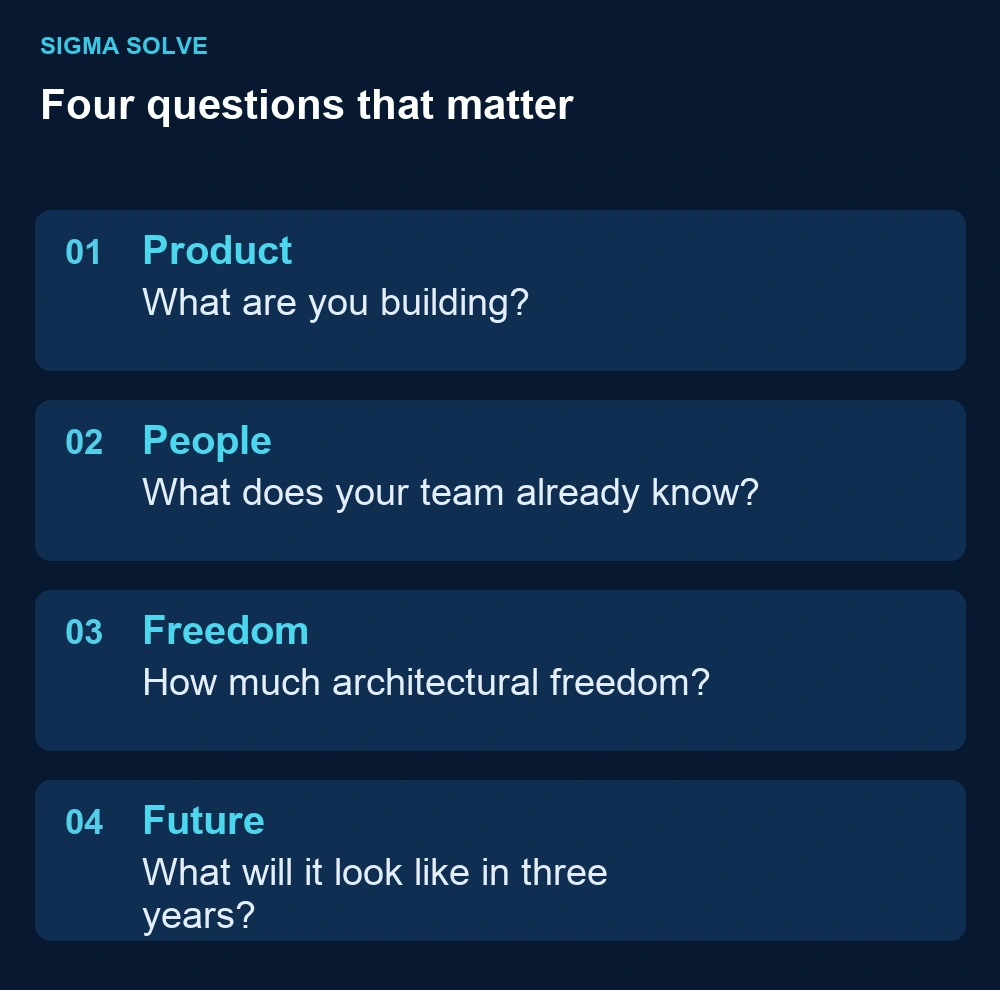
Skip the checklist-style pro/con list. Four questions do the real work:
- What are you building? A highly customized, fast-evolving product experience favors React's flexibility. A product expected to follow a consistent structure across multiple teams favors Angular's conventions.
- What does your team already know? Existing expertise should carry more weight than framework popularity. A strong Angular team will ship better software on Angular than on a new framework chosen because it trends higher on job boards, and the same is true in reverse.
- How much architectural freedom does the organization need? Teams that benefit from choosing the best tool for each problem tend to lean toward React. Teams that benefit from reducing the number of decisions developers have to make lean toward Angular.
- What will this application look like in three years? Consider who maintains it after the original team moves on, how upgrades get managed, and how architectural standards get enforced without the people who set them.
Neither framework is unsuitable for the "wrong" category; React runs plenty of large enterprise systems, and Angular runs plenty of small ones. The variable isn't application size; it's how much standardization the organization needs versus how much freedom it can responsibly manage.
The Cost That Shows Up Later, Not on Day One
The initial development experience is the most visible part of this decision and rarely the most expensive one. The real costs show up in how fast new developers become productive, how many external dependencies need governing, and how painful upgrades are.
React's ecosystem is one of its biggest advantages, but choice requires governance; someone has to decide which libraries become the standard. That responsibility grows with the organization. Angular reduces those individual choices by providing a more integrated environment, trading flexibility for less day-to-day decision fatigue.
Both frameworks accumulate technical debt: React when flexibility goes ungoverned, Angular when applications don't evolve with modern framework practices. The framework with the easiest learning curve on day one is not automatically the cheapest one to run for five years.
React vs Angular: The Final Verdict
React and Angular are both mature technologies capable of supporting modern, large-scale applications. The decision between them should not be based on outdated assumptions about which framework is faster, lighter, or more suitable for enterprise software.
The more meaningful difference is how each framework helps an organization manage complexity.
React gives teams greater freedom to define the architecture around their product. That flexibility can be a major advantage, particularly for organizations with strong engineering practices and requirements that do not fit neatly into a standardized model.
Angular provides a more integrated and opinionated development environment. That structure can make it easier to create consistency across large teams and long-lived applications where reducing architectural variation is an important goal. The right choice ultimately depends on the product, the team, the existing technology investment, and the way the organization expects to build and maintain software over time.
Choose React when flexibility creates more value than standardization, and your team has the discipline to manage that freedom well. Choose Angular when consistency, conventions, and an integrated development model provide greater long-term value. Neither framework is universally better.
The better choice is the one that allows your organization to build effectively today without creating unnecessary complexity for the team that will maintain the product tomorrow.
Build the Right Technology Foundation
Choosing between React and Angular is only one part of a broader technology decision. The long-term success of an application depends on the architecture behind it, the way the system is designed to evolve, and whether the technology choices support the organization's product and engineering goals.
Sigma Solve helps businesses build, modernize, and scale digital applications with technology architectures aligned to both immediate requirements and long-term growth.
Talk to our product engineering team to evaluate the right approach for your application.
Connect With Us.